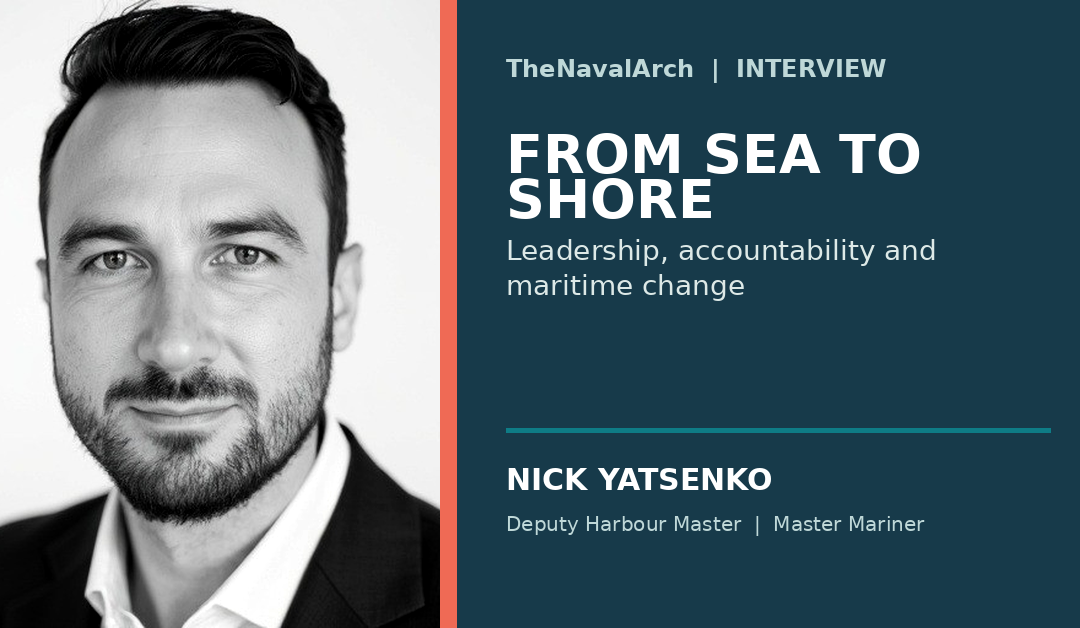
Nick Yatsenko’s maritime career began in a seafaring family and took him from deckhand to ship Master, then into ship management and port leadership. In this interview, he reflects on command during a major vessel fire, the culture shock of moving ashore, the value of competence and accountability, and the pressures reshaping modern shipping.
About Nick Yatsenko
Nick Yatsenko is a Master Mariner and Deputy Harbour Master with experience spanning deep-sea vessel command, ship management, vessel traffic services, pilotage, towage, emergency response and port operations. He also works at the intersection of maritime operations, data analytics and digital transformation, and supports seafarers preparing to move ashore.
Could you briefly tell us how your maritime career began and what initially drew you to the profession?
I grew up in a seafaring family, so in many ways the career chose me. My father was a chief engineer and my grandfathers went to sea, so I was surrounded by that world early on.
At the time, it was also a practical decision: good money, a chance to travel, and a way to build something solid out of a pretty rough environment. The sea gave me structure and direction when I needed it most.
When I was young, there was a strong cultural expectation to get a degree. It was seen as the default path for social mobility and status. Ideas like gap years or ‘finding yourself’ were not really part of the equation. You picked a profession and got on with it.
I was more drawn to reading, writing and debating, and at one point my dad asked what the plan was. He said I had the freedom to choose any profession. I told him, ‘I think I want to study philosophy.’ He said, ‘Righto, let’s get you into the Marine Academy.’
Being an engineer himself, he probably did not see much difference between the two.
Looking back at your years at sea, what experiences had the biggest impact on how you operate today?
One of the defining moments was a major fire onboard a vessel while I was Master. We were alongside in Port Kembla discharging cargo and it escalated quickly. In the end, we had to abandon the vessel while still alongside. The fire burned for days and the ship was declared a total loss.
It was not a situation anyone wants to be in. But handled well, those moments bring a kind of satisfaction that is hard to find elsewhere. In an emergency, there is no bureaucracy, no politics and no second-guessing, just raw decisions with immediate consequences.
There is no one to call and no manual to lean on. You are accountable for decisions that can prevent or cause catastrophic outcomes, and you often have minutes to act. It did not help that my pregnant wife and young son were onboard at the time.
What it taught me is that leadership under pressure comes down to staying calm and being clear. Even if you are unsure, you cannot show it. The team takes its cue from you.
As the saying goes, ‘More is lost by indecision than wrong decision. Indecision is the thief of opportunity.’
Some people are naturally calm, but that is not enough. You need to be competent, understand your systems and procedures, and train until your responses become instinctive.
Two things helped me. First, visualisation. Running scenarios in your head builds familiarity. When something actually happens, it feels less new and you can react faster. Second, always having a plan B. It does not have to be perfect. Even if it is inferior, it reduces panic when the first plan fails.
Everyone has a plan until they get punched in the face.
What aspects of life at sea are most misunderstood?
People think shipping runs on strict quality management and preventive maintenance systems. In reality, it runs on the actions and decisions taken by the crew.
From the outside, everything looks structured: regulations, checklists and systems. In practice, ships are complex, ageing systems held together by experience and judgement. Layers of modifications, workarounds and fixes build up over time, and very little of that is captured properly in procedures.
When something breaks, you do not stop and wait for the service contractor to arrive. You fix it yourself, and that often means improvisation and making decisions that are not written anywhere. Global trade runs because people make it work, not because the system always works as intended.
The second misconception is the organisational structure. On board, management is highly hierarchical, with a clear and enforced chain of command. The Master carries ultimate responsibility. When something goes wrong, there is no committee and no consensus. There is a decision, and that shapes behaviour across the vessel.
It also limits how far people challenge. There is a major difference in power distance between various nationalities. Some are comfortable questioning authority; others are conditioned not to, even when something does not look right. For someone joining for the first time, that can be confronting. You are far from home, operating in a strict hierarchy, and mistakes have real consequences.
Shipping runs on authority, judgement and people prepared to work in difficult conditions for long periods at sea.
What are the biggest challenges when moving ashore?
The biggest challenge is cultural.
At sea, life is brutally simple in a way that people ashore often do not understand. You know what your job is, you know who is responsible, and when something goes wrong you deal with it, fix what you can, and move on to the next problem. There is very little patience for ambiguity.
Ashore, it is almost the opposite. Decisions take much longer than they should. There are more stakeholders, more opinions, more meetings and often much less clarity. You can see what the obvious solution is, sometimes within five minutes, but that does not mean anything happens. In some cases, no one even seems to know who actually owns the decision, which for someone coming from sea can be maddening.
At sea, you are used to seeing a direct connection between action and result. You do something and the effect is real and immediate. Ashore, you can feel like a very small part of a much larger machine. You are one of many, and your value is not always obvious.
Communication is another adjustment. At sea, it is direct because it has to be. Ashore, that same approach can be seen as blunt or confrontational.
Most seafarers have the capability to succeed ashore, but they need to adapt.
What skills were most valuable moving from sea to shore?
The biggest one is problem solving. That is what the job at sea is really about. You are constantly dealing with situations with no clear answer and very limited support.
Engine failure when the weather is turning bad, another vessel on a collision course, or a cargo plan that simply does not work within the constraints you have. None of those problems arrives with a clean solution attached. You have to assess it quickly, make a call, and accept that you will live with the consequences of that decision.
The second part is responsibility and accountability, and that is something the industry teaches very early. If something sits in your area, it is yours. If it fails, you explain why.
That might sound harsh, but it builds a certain mindset. You do not look around for someone else to fix it. You take it on, sort it out and move on.
That combination of problem solving and ownership is what makes people with a seagoing background very reliable in the office environment.
Emergency management is another key skill. You cannot spend years at sea without ending up in situations that are genuinely dangerous: fires, blackouts and critical equipment failures. You learn to stay calm and make decisions under pressure because the consequences could be catastrophic and immediate.
In simple terms, you take ownership, solve problems and deliver outcomes.
What advice would you give to young officers?
Be clear on why you are doing it.
Shipping still builds discipline and responsibility early, but it is no longer the only path. Young people today have more options. If you go for easy money and travel, you may be disappointed.
If you go to build character and real decision-making experience, it is one of the strongest foundations you can get.
Focus on becoming competent. Do not think of it as one career. The industry is much bigger than the ship. Start looking beyond it early and develop transferable skills.
How has the industry evolved?
The job is changing.
There is more oversight, more monitoring and more pressure coming from every direction. At the same time, there is less freedom to apply judgement. Processes are being standardised and automated, which brings consistency, but it also means you carry the same level of accountability without having the same level of control over how things are actually done.
The administrative burden keeps growing as well. Every incident tends to result in more procedures. Over time, it stops being about safety and turns into proving compliance. You are showing that the box was ticked, not necessarily that the job was done properly.
At the same time, the operating model itself feels stretched. You have ageing, complex vessels running with minimal crews and increasingly unrealistic maintenance expectations. On paper it works, but in reality it relies on people constantly bridging the gap.
The job is also less rewarding in some ways. Ports are further away from cities and shore leave is restricted, so you do not get much of a chance to explore the world.
Technology enables safer operations, but it is flattening the skill set. Voyage planning and navigation used to feel like a craft that required time, attention and a bit of pride. Now, with the help of GNSS and ECDIS, it is faster but also less engaging.
That said, it is not all negative. The industry is safer than it used to be and it is cleaner. Fewer people are getting hurt and environmental standards are improving.
What trends will shape the future?
There is a lot of talk about AI and autonomy, and some of it is valid. Unmanned vessels will exist, but in very specific niches where the risk is controlled and the environment is predictable: defence, research and certain coastal operations. Beyond that, I struggle to see it scaling across the global fleet any time soon.
The bigger shift is coming from outside the industry, not from within it.
We are seeing increasing legal exposure. Incidents are leading to serious criminal accountability. At the same time, geopolitical risk is rising. Seafarers are increasingly exposed to conflict zones and situations beyond their control.
Trade itself is becoming less stable as well. Tariffs, shifting supply chains and political decisions are constantly forcing operators to adjust.
So the industry is not really being reshaped by technology alone. Technology will play its part, but it is not the main driver.
What is really changing is the environment around it. Legal, political and economic pressure is increasing, and with it the consequences of every decision made, whether you are at sea or sitting in an office ashore.
What inspired your idea of writing a book?
I saw a gap.
There are not enough people with real sea experience moving ashore anymore. If you look back, a lot of the major shipping companies, like MSC and Maersk, were built by people who actually went to sea. They understood the operation from the inside, and that showed in how those organisations were run. That connection feels weaker now.
Today the industry feels more corporate and more disconnected from operational reality. At the same time, many seafarers struggle with the transition. It is harder than expected.
That is where the idea of the book came from.
It is not meant to be anything complicated. It is intended to bridge that gap a little, show what opportunities exist beyond the ship, and be honest about what people are walking into when they make that move.
If more seafarers can transition successfully, the industry benefits.
What advice would you give your younger self?
Be deliberate about who you work for.
At the start, you might have to take whatever you can get just to get your foot in the door, and that is fine. But do not stay there longer than you need. Move on quickly to reputable operators.
I would also push hard on getting the right certifications early: tanker, gas and offshore. Those sectors tend to have better standards and better margins, and that translates into better conditions and better long-term opportunities.
At the same time, understand your rights and protect yourself. Most of the time things are fine, but when they are not, they can go wrong very quickly.
Be disciplined with money. You start earning decent money quite young, and it is easy to burn through it. I would tell myself to be far more disciplined. Save, invest and think long term.
Use your time on board productively. Most people end up watching movies or just passing time, which is understandable, but it is also a wasted opportunity. I would push myself much harder to learn something new consistently. That could be formal study, short courses or anything that builds a skill you can use later: data, coding, new technologies, whatever gives you an edge when you eventually look beyond the vessel.
Relationships matter as well. The industry is global, but it is surprisingly small. Talk to people, stay curious and build a network that goes beyond your immediate environment. Most opportunities come through people, not job boards.
Finally, trust your instincts. If something does not feel right, it probably is not.
Related Reading
Explore more conversations with maritime leaders in TheNavalArch Expert Interviews.