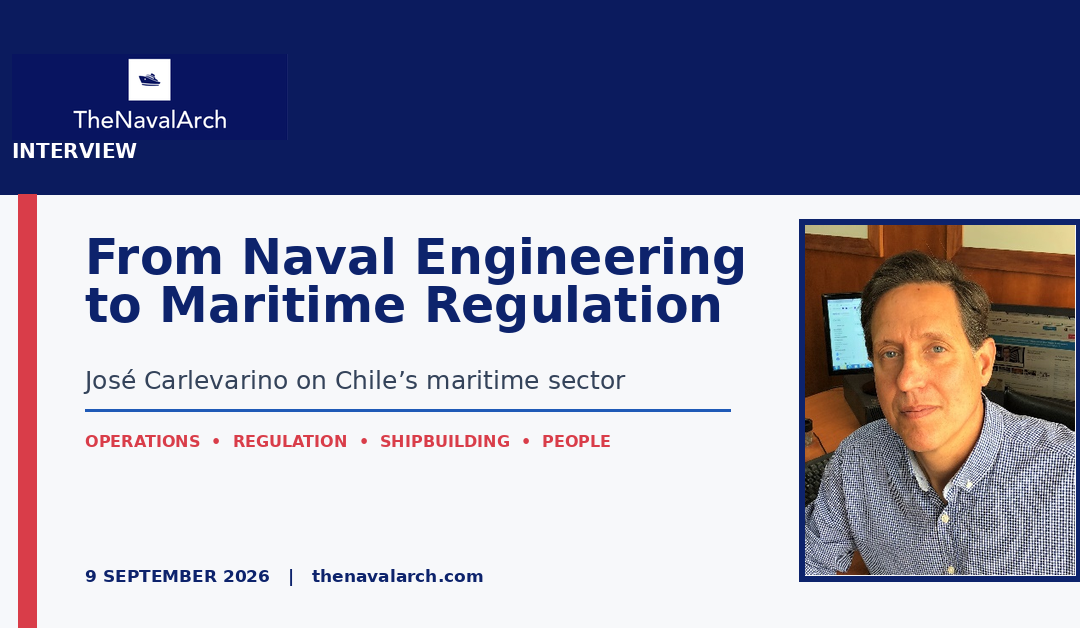
Drawing on a career spanning naval engineering, ship operations, maintenance, logistics, education, shipyard leadership and flag-state inspection, José Carlevarino reflects on Chile’s maritime regulatory system, industrial capability and the priorities that will shape the sector’s next decade.

José L. Carlevarino Girardi
Electrical Naval Engineer and Flag State Ship Inspector
José’s career spans naval operations, ship maintenance, logistics, maritime education, shipyard leadership and flag-state inspection in Chile.
Photo supplied by José L. Carlevarino Girardi.
Interview
1. Could you introduce yourself and describe your path from naval engineering to maritime inspection and logistics leadership?
My name is José Carlevarino. As an officer of the Chilean Navy, I specialised in Electrical Naval Engineering and later completed studies in business administration. Those disciplines complemented each other throughout my career and helped me approach processes from several perspectives: as a user, client and administrator. My focus was consistently on maintaining and improving the availability and reliability of naval assets so they could fulfil their assigned missions.
I served aboard five warships, acting as Chief Engineer on four of them, and participated in a frigate renewal project and national and international naval operations. I also managed ship-maintenance plans for Navy warships and DIRECTEMAR patrol vessels. Later, I contributed to the training of officers and enlisted personnel, served as Deputy Director of the Naval Polytechnic Academy and concluded my naval career as Deputy Director of ASMAR.
2. You have worked in operations, maintenance, logistics, shipyard management and flag-state inspection. Which roles most shaped your view of the maritime industry?
The roles build on one another. Flag-state inspection has given me the broadest industry view, while operational and maintenance roles provided firsthand experience of the practical challenges faced by ship crews. Logistics and shipyard management added the perspectives of shipowners and managers, for whom operating costs, maintenance, availability and the safety of people and equipment are all critical.
3. For readers outside Chile, how would you describe DIRECTEMAR and the country’s maritime regulatory framework?
DIRECTEMAR is Chile’s maritime authority and operates within the Chilean Navy. Its responsibilities include maritime safety, protection of human life at sea, enforcement of national laws and applicable international agreements, protection of the aquatic environment and regulation of maritime activities within its jurisdiction.
Its work brings together naval personnel and civilian specialists. Oversight extends across national and foreign vessels calling at Chilean ports, ports and shipyards, navigable rivers and inland waters, and the areas in which Chile holds search-and-rescue responsibilities.
4. Given the complexity of vessel inspections, what broad factors contribute to strong safety and compliance outcomes?
Maritime activity is governed by an extensive regulatory and legal framework, so it is difficult to reduce inspections to one recurring issue. In my experience, effective oversight by the maritime authority, together with preventive measures adopted by companies and vessels, supports strong safety and compliance performance.
5. How do Chile’s coastline and environmental conditions influence vessel operations, maintenance and port infrastructure?
Education, prevention and safe operating practices are essential. DIRECTEMAR and the broader maritime community both have an active role. Chile’s adoption of international conventions has also helped standardise activities and establish a robust regulatory framework for operating in demanding conditions.
6. What operational and engineering challenges do terminal operators in Chile face today?
Chile’s geography, growing commercial activity and the effects of climate change create a need for solutions that improve operational safety, manage risk and reduce port stays and non-operational windows caused by swell or adverse weather. Engineering studies, including mooring evaluations and operational analyses, can help operators understand these constraints. The wider challenge is to integrate new technologies with existing fleets and infrastructure while controlling costs, preventing accidents and extending the service life of expensive maritime assets.
7. What role does ASMAR play in Chile’s maritime and shipbuilding industry?
ASMAR was established in 1960 as a state-owned enterprise with autonomous administration, building on Chile’s naval-shipyard capabilities. It supports the Chilean Navy and provides maintenance, repair, modernisation and construction services to national and international maritime clients through facilities in Valparaíso, Talcahuano and Punta Arenas.
The National Continuous Shipbuilding Policy gives long-term direction to the renewal of auxiliary, logistical and fleet units while strengthening domestic industrial capability. ASMAR is central to that effort, alongside other parts of Chile’s shipbuilding ecosystem.
8. What leadership and project-management lessons did you learn from complex maintenance and infrastructure programmes?
Planning must begin with a clear definition of the capability and availability required when the work is complete. Resource-allocation tools are important because financial, material and human resources are always limited. It is equally important to train and retain specialised professionals and give them the right tools throughout their education and careers. These capabilities require long-term commitment and investment.
9. After the 2010 earthquake and tsunami, you coordinated work involving 1,500 emergency homes. What did that experience teach you?
The damage to infrastructure was immense. Initiative and ingenuity at every organisational level were essential to overcome the logistical challenges of acquiring, transporting and supporting the delivery and construction of the emergency homes. But initiative alone is not enough. Effective crisis response depends on people who are motivated, disciplined, equipped, trained and technically prepared. Those capabilities cannot be created overnight; they require continuous education and development.
10. Where do you see the greatest opportunities for Chile’s maritime sector over the next decade?
The fleet and infrastructure are ageing, and I expect significant asset renewal and technological change, particularly in propulsion and electrical-power generation. The development of green-hydrogen projects in the Magallanes region is one example of that transition.
The opportunities will come from implementing technologies that may still be developing today. However, the central issue will remain professional capability. Chile has strong education and training capacity, but much of it is still oriented toward sectors such as mining and agriculture. Greater maritime awareness, and a deliberate effort to develop maritime skills, will be essential.
“The central issue will remain professional capability.”
About José Carlevarino
José L. Carlevarino Girardi is an Electrical Naval Engineer, Naval Staff Officer and maritime professional with experience in engineering, naval operations, maintenance, logistics, project management, ship inspection, education administration and shipyard leadership. He holds a Master’s degree in Strategic Management and an MBA and currently works in Valparaíso as a Flag State Ship Inspector. He is fluent in Spanish and English.