
By João Henrique Volpini Mattos
Introduction
The main static stability rule governing the grouping of passengers on the same side is that the heel angle cannot exceed a certain value, in addition to various other stability criteria (minimum GM, minimum flooding angle, area under the stability curve, etc.), which are generally common to other types of vessels.
Internationally, this requirement is dictated by the International Maritime Organization’s (IMO) Code of Intact Stability (ISC 2008) adopted by Resolution MSC.267(85), that requires a maximum of 10° of heeling angle when all passengers go to the same side.
In Brazil, the maritime authority (Brazilian Navy) applies this criterion through NORMAM-201 (for navigation in the open sea) and NORMAM-202 (for inland navigation). NORMAM-201 requires 10° (same as IMO), and NORMAM-202 requires 12° or 15° maximum, depending on if Area 1 or Area 2, among other differences that are not affected by the transverse movement of passengers.
In NORMAM-202, Areas 1 and 2 refer to the subdivision of Inland Navigation, which is carried out in sheltered or partially sheltered waters, such as rivers, lakes, lagoons, bays, and channels.
The fundamental distinction between them is based on the level of protection against environmental agents (winds, waves, and currents)
• Area 1 (Very sheltered waters): Covers lakes, lagoons, rivers, channels, and very sheltered sea areas (such as protected bays). These are places where there is no incidence of large waves or strong winds that pose risks to navigation. • Area 2 (Partially sheltered waters): Refers to stretches where vessels are subject to larger waves and/or more adverse environmental conditions (wind and current) that make navigation more difficult. It generally requires more robust vessels and specific lifesaving equipment.
The Brazilian standard for inland navigation considers a maximum density of 4 standing passengers per square meter and requires evaluation of stability with maximum passenger capacity. Also, for ferries services lasting less than 1 hour, is allowed to have standing passengers.
Between the years 2013 and 2024, I was the naval architect responsible for the fleet of 19 vessels (some monohulls, some catamarans, some having a single deck, others tween decks, from 250 to 2000 passengers’ maximum capacity), traveling in Guanabara and Ilha Grande Bays. Although I did not participate in these projects, I’ve always been concerned with the safety aspect of this operation, the fourth largest in the world, transporting about 20 million passengers/year over more than 400,000 miles.
Calculations made with several vessels show that the moment of capsizing with passengers on a board can be greater with less capacity.
Several other aspects of stability and comfort in passenger transport are also discussed, comparing the rules of existing criteria and regulations.
Hypotheses
The calculation and the assumptions for the application of this technical criterion are structured as follows:
The Passenger Grouping Criterion
Crowds of passengers on one of the sides of the vessel are not difficult to occur, and can be divided into two types:
- External reasons, usually caused by the curiosity of passengers, who crowd on board in order to see dolphins, sharks, whales, corpses, external accidents, etc. Other causes such as running away from the sun, rain, splashing waves, etc., are also common.
- Reasons internal to the vessel, usually causing panic: gases, smoke, fire, poor stability, etc.
When all the people on board run to the same side of the ship. a capsizing moment (Mp) is generated. The standard requires that:
- Maximum angle: The static inclination resulting from the drive must not exceed 10°.
- Immersion: The main deck does not touch the water.
Human Mass Calculation Parameters
To simulate this condition in the official calculations of the ship’s Stability Leaflet, the standards establish standardized weight and distribution values:
- Weight per passenger: An minimum weight of 75 kg per person is considered. Brazilian rules allow 25 kg per passenger as luggage, depending on the route.
- Space distribution: An extreme concentration of 4 people/m2 is assumed in the available deck areas.
- Passengers center of gravity: – Standing: The individual center of gravity is calculated 1.0 meters above the deck. – Seated people: The individual center of gravity is calculated at 0.3 meters above the seat.
- Passengers should be distributed in such a way as to produce the most unfavorable combination that can be verified in practice for the capsizing moment due to the grouping of passengers on one side and/or vertical position of the center of gravity in the condition.
Sample Calculation

A simple observation of the arrangement of this vessel (2 seats/m2 and 2 standing passengers/m2 initial capacity) indicated that the grouping of passengers on one side resulted in a greater moment of capsizing when there were no standing passengers in the loading condition under analysis, freeing up space for passengers seated on one side to group on the opposite side.
The previous figure shows us a hypothetical example of capsized moments: in (a) the initial condition already presupposed trip with standing passengers, while in (b), with half capacity, all passengers were initially seated.
On the other hand, in Figure 3, on longer trips where only seated passengers are allowed, the capsizing moment at full capacity is greater than at half capacity.
We concluded that the capsizing moment with passengers on the same side depends on the internal arrangement of the deck, as well as the initial condition.
Whenever during the analysis of the accumulation of passengers on a board it is verified the possibility that an intermediate condition, with a number of people lower than the maximum expected passenger capacity, resulting in a more critical loading condition, an analysis verifying which is the most severe capacity and distribution of passengers and the full compliance with the stability criterion in this condition must be presented in the vessel’s stability leaflet. If during this analysis it is found that the vessel does not meet the stability criteria in a certain intermediate condition, the maximum capacity of passengers must be reduced until it is fully met in any condition. We then decided to test the rest of the fleet.
Rules Used on Calculations
As a basis, we use the Brazilian NORMAM-202 rules for navigation in inland waters, especially in Area 1 (sheltered waters), but it is very similar to other rules. Its general criteria we have:
- The static equilibrium angle of the vessel (θ1), when subjected to the isolated action of passenger accumulation on one side, wind, turning maneuver or towing (where applicable) shall be less than or equal to the immersion angle of the deck in the considered loading condition or 15°, whichever is less;
- The area between the static stability curve (CEE) and the capsizing arm curves due to passenger accumulation on one edge, wind, turning maneuver, or towing (where applicable), up to the flooding angle (θf) or 40°, whichever is smaller (area A2 on below figure), shall be greater than or equal to the area under the capsizing arm curve before intersection with the static stability curve (area A1);
Stability criterion for Area 2 is very similar to Area 1, the main difference being the static equilibrium angle, which becomes 12°, and the ratio between the areas below the EEC, which is increased to 1.2.
- The area occupied by the passengers grouped on each deck must be equal to the number of passengers transported on the deck considered by the assumed concentration (4 people/m2);
- The rules below set out parameters of habitability for standing passengers. • Application – The transport of standing passengers can only be carried out on trips used in crossings of up to 1 hour in duration or on sightseeing tours without an overnight stay on board.
- Minimum Area Required – The minimum area required for the transport of standing passengers in vessels used in crossings lasting up to 1 hour is obtained considering the concentration of 4 passengers/m2. – The minimum area required for the transport of standing passengers on vessels used in sightseeing tours, without overnight stay on board, is obtained considering the concentration of 1.5 passengers/m2. – In the calculation of these areas, the areas for luggage storage or cargo transport, nor the stairs, may not be computed.
Curves of Moment x Number of Passengers
We demarcated the free areas of the deck (those where passengers could group standing) and drew longitudinal dividing lines at various points – preferably between the rows of chairs, facilitating the calculation of the capsizing moment. The transformation of these areas into regions using AutoCAD (BOUNDARY command) and the calculation of area and centroid (MASSPROP command) are trivial.
Using the density of 4 passengers/m2 and considering the weight of each one with 75 kg, and adding the moment of the passengers seated within the range, we can easily assemble the curves of Grouped Number of Passengers x TCG and x Moment.
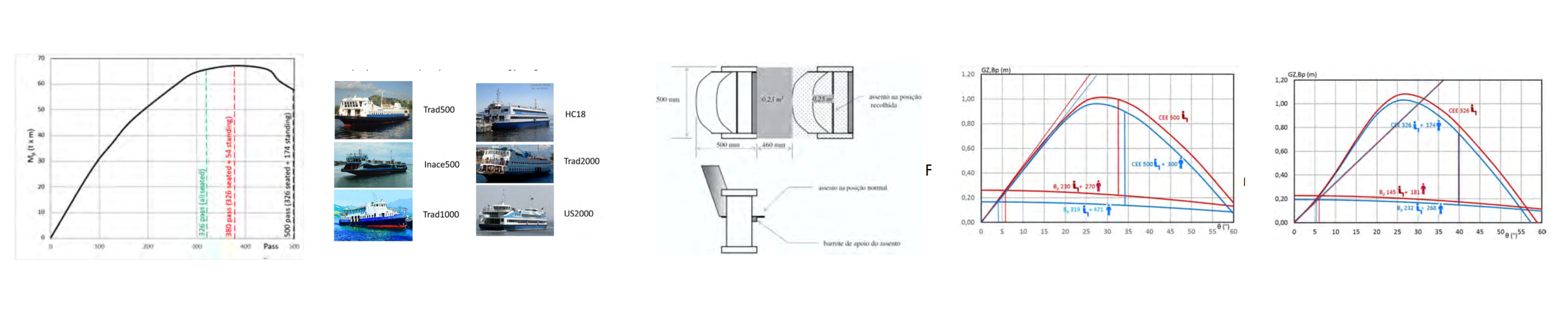
These curves showed consistency in the six classes of different vessels, with the maximum loading moment lower than the maximum passenger capacity.
The question to be raised is whether there is empty space that can be fully filled by the passenger grouping. I think the answer is NO, if these empty spaces are already being occupied by standing passengers! But if there are only passengers seated in the initial loading condition?
Vessels Analyzed
The documentation available from the fleet of the concessionaire that operates the transport of passengers in Guanabara Bay and Ilha Grande were used as a reference, and the vessels with the capacity to simultaneously transport seated and standing passengers were selected.
| Class | Trad500 | Inace500 | Trad1000 | HC18 | Trad2000 | US2000 |
|---|---|---|---|---|---|---|
| Passengers | 500 | 800* | 1000 | 1300 | 2000 | 2000 |
| LPP (m) | 39,00 | 52,00 | 40,64 | 48,42 | 53,00 | 77,40 |
| B (m) | 10,00 | 9,30 | 9,91 | 14,20 | 10,60 | 14,80 |
| D (m) | 3,00 | 3,20 | 3,25 | 4,00 | 3,70 | 4,00 |
| T (m) | 1,40 | 1,61 | 2,50 | 1,62 | 2,20 | 1,75 |
| Decks | 1 | 1 | 2 | 2 | 2 | 2 |
| Hull | MONO | MONO | MONO | CAT | MONO | CAT |
| Δ100% (t) | 220 | 380 | 426 | 324 | 715 | 633 |
| Class | Trad500 | Inace500 | Trad1000 | HC18 | Trad2000 | US2000 |
|---|---|---|---|---|---|---|
| Seat main deck | 326 | 500 | 222 | 384 | 374 | 448 |
| Stand main deck | 174 | 300 | 300 | 230 | 695 | 552 |
| Pass/m2 | 1,62 | 2,07 | 2,58 | 1,32 | 3.57 | 2,27 |
| Seat upper deck | N/A | N/A | 175 | 486 | 415 | 552 |
| Stand upper deck | N/A | N/A | 303 | 200 | 516 | 448 |
| Pass/m2 | N/A | N/A | 2,61 | 1,32 | 3,14 | 2,18 |
Although the Inace500 class was originally designed for crossings in Ilha Grande Bay, with a capacity of 500 seated passengers (draft of 1.45 m), in practice it is being used in Guanabara Bay. To this study, we are considering modifying its maximum draft and passenger capacity to include an additional 300 standing passengers.
We observed in Table 2 above that the density of standing passengers in the original condition varies between 1.6 and 3.6 passengers/m2, indicating that in some extreme cases its increase to 4 passenger/m2 due to their grouping on one side will not result in a very large moment of capsizing.
Just out of curiosity, using the minimum dimensions of chairs and distance between rows defined in NORMAM-202, the maximum density of seated passengers is 2.58 passengers/m2.
Comparison of Loading Conditions
We made a comparative analysis of the stability conditions with 100% of passengers (seated plus standing) and with only passengers seated, on the six types of vessels. Their original hydrostatic data, centers of gravity, and cross curves were used.


Comparative Summary
Comparing the conditions of partial passenger loading (seated only) with that of 100% full loading (standing and seated passengers), we had the following results:
| Class | Trad500 | Inace500 | Trad1000 | HC18 | Trad2000 | US2000 |
|---|---|---|---|---|---|---|
| Passengers | 65,2 | 62,5 | 39,7 | 66,9 | 39,5 | 50,0 |
| Δ | 95,6 | 92,1 | 89,4 | 90,5 | 84,5 | 85,1 |
| VCGcorr | 98,8 | 97,5 | 93,9 | 98,1 | 92,5 | 94,4 |
| MP | 112,2 | 144,5 | 118,8 | 102,4 | 179,0 | 120,3 |
| BP | 121,1 | 162,5 | 135,0 | 113,7 | 213,3 | 140,0 |
| GMcorr | 100,0 | 107,2 | 122,2 | 115,4 | 155,4 | 110,3 |
| GZmax | 104,9 | 106,2 | 130,0 | 101,1 | 153,5 | 102,9 |
| θgzmax | 101,1 | 107,3 | 110,7 | 98,7 | 120,4 | 95,7 |
| θ1 | 113,0 | 137,5 | 118,2 | 104,8 | 156,7 | 118,2 |
| Θf | 100,4 | 104,9 | 111,8 | 106,2 | 132,8 | 107,6 |
| A2/A1 | 75,9 | 40,1 | 98,3 | 85,4 | 39,2 | 58,9 |
In conditions with only seated passengers (40 to 60% of the total passengers) there is a drop in displacement between 5% and 15%. Obviously, this smaller displacement, associated with a decrease in the height of the center of gravity (between 2% and 6%) leads to greater initial stability (higher GMcorr) as well as at large angles (GZmax, θGZMAX). However, the greater capsizing moment (from 2 to 80%), associated with the smaller displacement, leads us to larger capsizing arms (from 13% to more than 100%), implying greater angles of static equilibrium θ1 (5% to almost 60%), with a reduction of 2 to 60% between the A2/A1 area ratios.
Brief Analysis of Parameters and Criteria
Several items are not clarified or are not well defined in NORMAM-02 on stability in passenger vessels, leading to different interpretations by various designers.
In addition, a quick analysis shows us very different criteria from those used for inland navigation in most countries.
Navigation Area
NORMAM-202 classifies navigation areas into two, for the purpose of applying the rules:
- Area 1: Sheltered areas, such as lakes, lagoons, bays, rivers and canals, where waves with significant heights that do not present difficulties to vessel traffic are not normally verified.
- Area 2: Partially sheltered areas, where waves with significant heights and/or adverse combinations of environmental agents, such as wind, current or tide, are occasionally observed, which hinder the traffic of vessels. The areas of inland navigation considered as area 2, for the purpose of applying the standard, are described in the CP and CF Standards and Procedures (NPCP/NPCF)
Taking the example of the Port Authority of Rio de Janeiro, it establishes the areas in its jurisdiction based on more defined criteria:
- The traffic of vessels classified inland, with sail and/or engine propulsion, with a length greater than five meters and equipped with VHF, is allowed within the delimited area, only when favorable weather conditions and sea state limited to strength 1 on the Beaufort scale (1 to 3 knots of wind speed and sea aspect creased in small wrinkles, with the appearance of scales.).
- Traffic of passenger transport vessels, schooners and sloops approved for Area 2 is conditioned to conditions of limited sea state up to force 3 on the Beaufort scale (7 to 10 knots wind speed Slight swells of 30 cm (1 foot), with crests, but no surf.) and there is no forecast of deterioration of meteorological conditions.
Although the stability criteria are a little stricter in area 2, in both areas the wind speed considered is 80 km/h (43 knots or 22 m/s).
International laws provide that each State must classify its inland waterway waters in accordance with international law:
- The internal waters are those inside the coastline (the low tide line of the coast) and the State has full sovereignty over them (rivers, watercourses, lakes and even small bays).
- The territorial sea of the States extends up to 12 nautical miles from the coastline. The nation is free to establish laws and regulate their use, as in its own territory and its internal waters.
For the purposes of wave height, most of Europe, through the UNECE (2006) divides inland navigation into three zones: zone 1 with a significant maximum wave height of 2.0 m, zone 2 with 1.2 m and zone 3 with 0.60 m.
The United Kingdom defines three areas of operation similar to those of the UNECE, and adds a fourth for small rivers and canals with a depth of less than 1.5 m.
China establishes three categories of vessels for inland navigation: category A for significant wave height of up to 2.5 m, B for 1.5 m, and C for 0.5 m.
Russia has three similar categories but adds another for 3 m waves (Lakes Ladoga and Onega).
The way these heights are defined varies, ranging from 1 to 10% of the highest heights, depending on the country.
It is also interesting to note that the wind speed considered in the stability calculations also varies depending on the navigation zone.
Free Area for Passengers
How to treat the areas occupied by chairs?
- Consider that each seat continues to be occupied by 1 passenger, with no additional passenger between them?
- Consider that the passengers will be standing on the chairs and that there will be additional passengers between them?
- Consider that in the area of the seats the passengers will also crowd with a density of 4 passengers/m2 ?
- Consider a grouping density in the seats specified in another standard (e.g. DNV) with 2.67 passengers/m2)?
- Consider that the seats will have the seat retracted in their upright position and passengers will only use the area between them?
- Should the free area consider spaces outside the passenger lounge, which when traveling would be out of your reach? In the stability analysis of the US-2000 class, the area outside the passenger lounge is considered as a free area, capable of having passengers grouped together, although it is separated from the lounge by watertight doors of automatic closing that can be manually unlocked by an emergency button.
Should the areas occupied by standing passengers in the condition of movement to the board include the areas reserved for cargo? It should be considered that these areas are usually separated from the passenger areas by tapes or markings on the floor.
Righting Arm Curve
The righting arm curve or static stability is usually calculated by considering the position of the center of gravity in the initial condition, when part of the passengers are seated. However, in the agglomeration of passengers on board, most of the passengers who were seated stand up, changing the vertical position of the center of gravity of the condition.
This change in the static stability curve is never considered, although it increases the equilibrium angle.

Flooding Angle Not Available
Although NORMAM requires the presentation of cross curves or tables and that the static stability curve must be interrupted from the corresponding flooding angle, in practice this is never met. Even the most detailed specification does not indicate the presentation of these flooding angle curves. As a result, the KN curves and tables never indicate the progressive flooding curve, making it impossible to verify new stability condition without a new hull modeling.
Deck Immersion Angle
Similar reasoning to that of flood angles can be applied to the deck immersion angle curve, which is also never presented.
Initial Passenger Density in Free Areas
Most rules allow a capacity of standing passengers at a density of up to 4 passengers/m2, and simultaneously indicates this same value for the grouping of passengers on board, we can reach the extreme case in which this grouping will not cause any moment of capsizing.
The figure allows us to have a good visualization of what the density of people means.
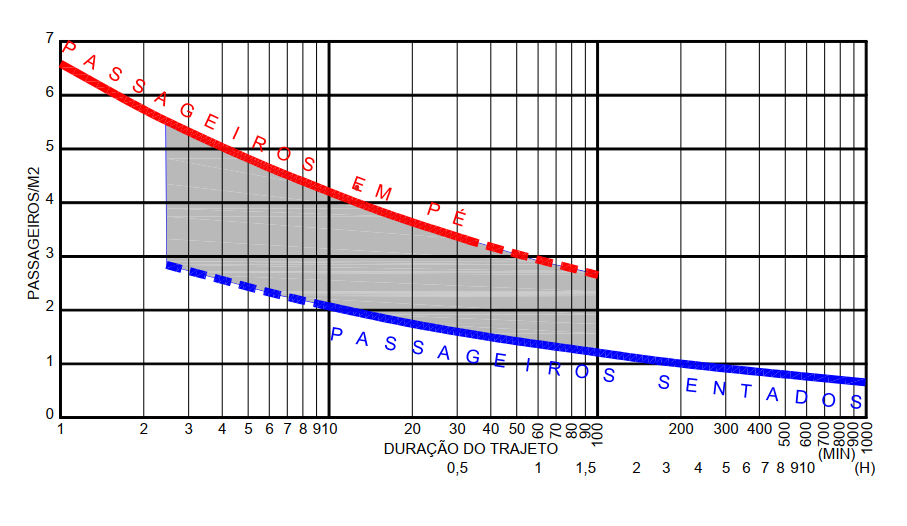
The ideal density of passengers in public transport considers the accelerations of the means of transport, the duration of the journey and the degree of comfort that is intended to be given to the passenger.
The following graph was taken from Bovy (1974), but these values easily exceeded at peak times.
Reck (2010) refers to some European studies, where a comfortable surface of 0.30 to 0.40 m2 per person standing is ideal for displacements of about 20 minutes.
Fruin (1971) developed a study based on the relationships between anthropometric characteristics, circulation conditions and psychological factors of people in agglomerations, resulting in the table below.
| Comfort level | Persons/m2 | Psychological factors |
|---|---|---|
| A | Under 0.8 | None |
| B | 0.8 to 1.1 | None |
| C | 1.1 to 1.4 | Comfort zone |
| D | 1.4 to 3.3 | Avoidable contact |
| E | 3.3 to 5.0 | Inevitable contact |
| F | Over 5.0 | Discomfort |
As a curiosity, the São Paulo Metro transports more than 8 passengers/m2 during its peak hours (the bearable limit, according to experts, would be 6 passengers/m2.)
Density of Grouping Passengers on a Side
Both DNV and Bureau Veritas and several other classification societies adopt a grouped passenger density of 3.75 passengers/m2 for the free areas, but on the other hand they establish very different criteria for intact stability, in addition to requesting an analysis of the stability in damage.
| Criteria | NORMAM Area 1 | NORMAM Area 2 | CFR | DNV/BV/IRCLASS/UNECE | MCA (UK) | RINA |
|---|---|---|---|---|---|---|
| θ1 (°) | ≤ θi or 15 | ≤ θi or 12 | *3 | *1 | ≤ 10 | ≤ 12 |
| Residual freeboard (m) | 0,00 | 0,20 | ≥ 0.20 | |||
| A2/A1 | ≥1 | ≥ 1.2 | *2 | *3 | ||
| GMcorr (m) | ≥ 0.35 | ≥ 0.15 | ||||
| θf (°) | ≥ 25 | ≥ 30 | ≥ θ1+3 | |||
| GZmax (m) | ≥ 0.10 | ≥ 0.15 | ≥ 0.20 | |||
| θGZMAX (°) | ≥ 25 | ≥ θf+3 | ≥ 30 | ≥ 25 | ||
| Injury criteria | NO | YES |
*1 : Some standards establish the maximum angle of balance only according to the grouping of passengers on board, while others combine this moment with the one due to wind or yaw separately. Some others combine the effect of the three (passengers, wind and yaw) in the equilibrium angle criterion. It should be noted, however, that wind speed is not the same in all these standards.
*2 : The area under the curve of the righting arms must follow parameters that are quite different from those of NORMAM, and absolute values are defined for them:
*3 : By CFR, MCA and RINA the righting arm curve must not have an area less than 0.055 m.rad up to 30° and not less than 0.09 m.rad up to θf or 40°, whichever is smaller. In addition, between 30° and θf or up to 40° must be greater than 0.03 m.rad.
The MCA also establishes a criterion of severe wind and simultaneous swing (atmospheric criterion) where a constant wind and a gust of wind are combined, also taking into account the period of play of the vessel.
Concluding Remarks
Although NORMAM-202 provides that there may be a more critical intermediate loading condition than the one with 100% passengers, experience shows us, after analyzing dozens of Trim and Stability Leaflets, that this is never done by the naval architects.
It would be interesting if the rules requires, for vessels carrying passengers seated and standing simultaneously, at least the analysis of capsizing due to the grouping of passengers on board, considering a loading condition with passengers only initially seated, when possibly the moment of capsizing due to their movement to an edge will be maximum or very close to it, and the curve of righting arms takes into account the vertical position of the resulting center of gravity.
Several rules require that there be a residual freeboard when there is an accumulation of passengers on board, while Brazilian rule only requires that there is no submersion of the deck.
NORMAM-202 requires stability analysis for isolated action of passenger grouping on a side, wind, turning maneuver or towing. We verified, however, as usual for accidents, that most shipwrecks have occurred when there is simultaneity of the accumulation of passengers with the occurrence of waves/crosswind. Some of the rules add their effects to the calculation of the equilibrium angle, without the criterion of the A2/A1 ratio.
About the Author
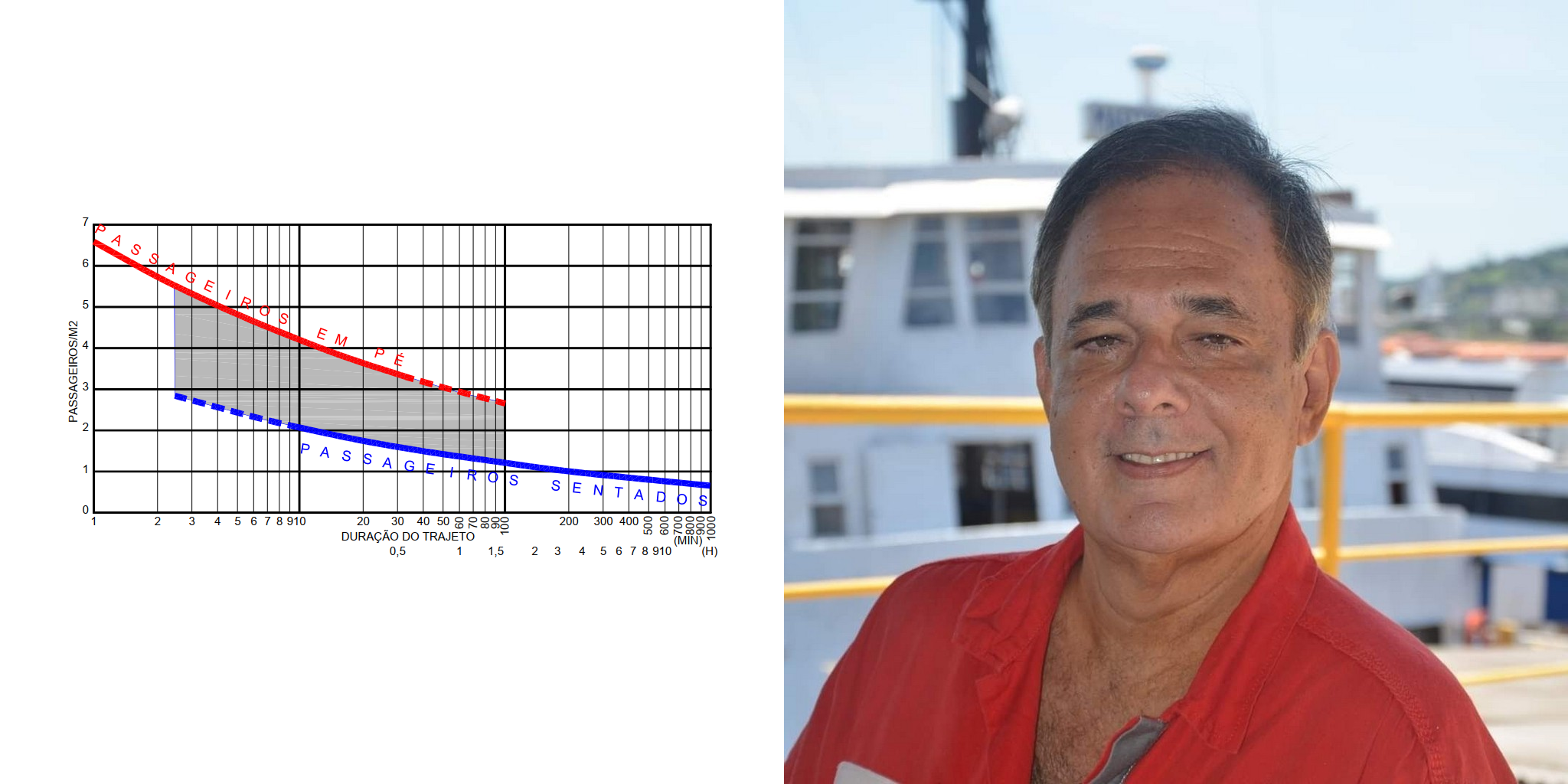
João Henrique Volpini Mattos is a Naval Architect and Marine Engineer with a degree from UFRJ. With over 45 years of experience focused in naval architecture and structural analysis. He worked at DNV and served as technical manager for the CCR Barcas fleet for the last 13 years. He holds MBAs in Systems Analysis and C#, and is active in the development of engineering software. He currently teaches in the Shipbuilding MBA programs at IPETEC-UCP and remains active in naval engineering projects.
Connect with João Henrique Volpini Mattos on LinkedIn
Bibliographic References
ABS AMERICAN BUREAU OF SHIPPING. Rules for Building and Classing – Steel Vessels for Service on Rivers and Intracoastal Waterways 2025, Houston, USA, 2025, 417p.
BAČKALOV, I. Stability of European Inland Vessels : Deterministic Regulations vs. Probabilistic Approach In Congresso Internacional de Ingenieria para el Desarrollo Sostenible IDS2013, Iquitos, Peru, July 2013, 19p.
BOVY, H. Les Transports en Commun, workbook of the course “A mánagement du territoire et transports II”, ITEP – Institute de Technique des Transports, Lausanne, France, 1974
BV BUREAU VERITAS. NR217 Rules for the Classification of Inland Navigation Vessels – Part D Additional Requirements for Notations – Chapters 1-2-3, Paris, France, June 2025, 398p.
CBESP FIRE DEPARTMENT OF THE STATE OF SÃO PAULO. Technical Instruction No. 12 – Sports and Exhibition Centers – Fire Safety Requirements, São Paulo, Brazil, 2011, 26p.
DATAFOLHA. Datafolha Methodology for Crowd Counting, São Paulo, Brazil, 2011, downloaded from http://media.folha.uol.com.br/datafolha/2015/03/16/slides_contagem.pdf on 08/11/2018
DEPARTMENT OF HOMELAND SECURITY – COAST GUARD. Title 46 Code of Federal Regulations – Shipping – Subchapter S – Subdivision and Stability, Washington DC, USA
DNV. Rules for Classification – Inland Navigation Vessels – Part 5 Ship Types – Chapter 5 Passenger Vessels, Oslo, Norway, December 2015, 27p.
IRCLASS INDIAN REGISTER OF SHIPPING. CLASSIFICATION NOTES – Stability Requirements for Inland Waterways Passenger Ships, Mumbai, India, November 2017, 13p.
BRAZILIAN NAVY – DIRECTORATE OF PORTS AND COASTS. NORMAM-202/DPC: Maritime Authority Standards for Vessels Employed in Inland Navigation, Rio de Janeiro, 2025 including modification 2, 657p.
BRAZILIAN NAVY – CAPTAINCY OF THE PORTS OF RIO DE JANEIRO. Standards and Procedures of the Port Authority / RJ 2025, Rio de Janeiro, Brazil, 2012 including revision 3, 344p.
MCA MARITIME & COASTGUARD AGENCY – DEPARTMENT FOR TRANSPORT UK. Merchant Ship Notice 1823 – Safety Code for Passenger Ships Operating Solely in UK, Southampton, England, 2010, 215p.
RECK, G. Public Transport Workbook, UFPR – Federal University of Paraná – Department of Transport, Curitiba, Brazil, 2010, 108p.
RINA REGISTRO ITALIANO NAVALE. Rules for the Classification of Inland Waterway Ships and for Conformity to Directive 2006/87/EC – Part B Hull and Stability, Genoa, Italy, January 2013, 158p.
RUIN, JOHN J. Pedestrian Planning and Design, MAUDEP – Metropolitan Association of Urban Designers and Environmental Planners, New York, USA, 1971, 206p.
UNECE UNITED NATIONS ECONOMIC COMMISSION FOR EUROPE – INLAND TRANSPORT COMMITTEE. Recommendations on Harmozined Europe-Wide Technical Requirements for Inland Navigation Vessels – Resolution No. 61 – Revision 1, Geneva, Switzerland, 2006, 260p.