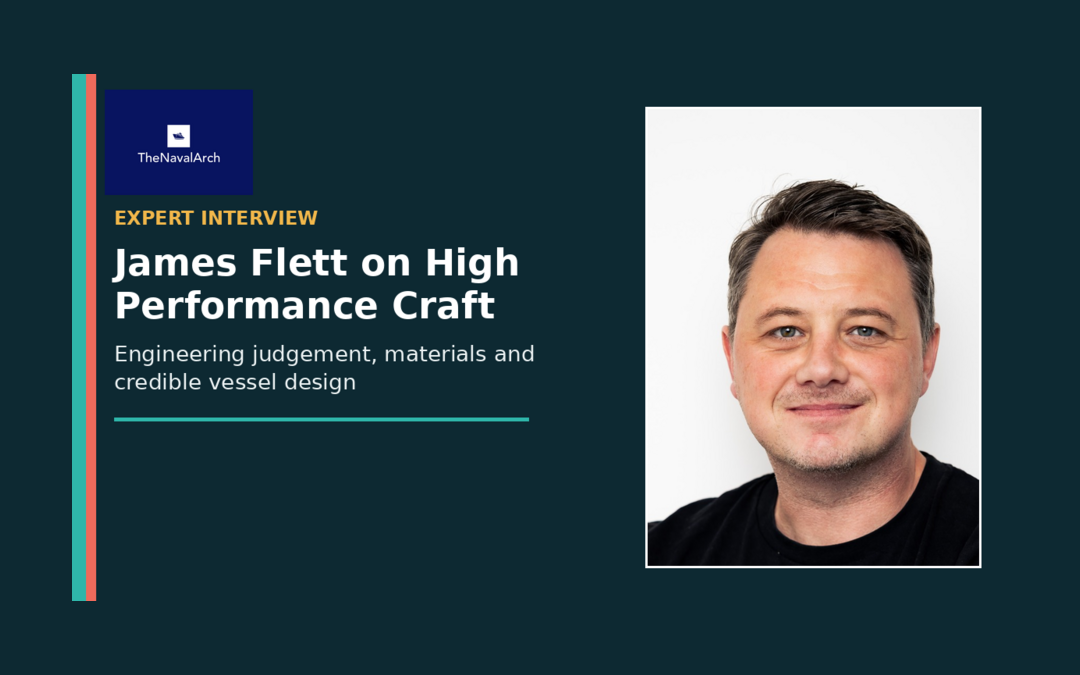
James Flett reflects on a career spanning shipyards,
established design offices and a wind-assisted shipping startup, and
explains how engineering judgement, material selection and systems
thinking shape credible vessel design.
About James Flett
James Flett is Engineering Manager at LOMOcean Marine Ltd, a
Chartered Engineer (CEng) and Professional Naval Architect (MRINA), with
more than 17 years of experience across leading shipyards, design
offices, consultancies and start-ups.
He specialises in advanced composite structures, with additional
expertise in aluminium and steel construction, first-principles
engineering, FEA, naval architectural analysis, vessel design
integration and project management.
His portfolio includes projects up to 87 m in length across monohull,
catamaran, trimaran and wave-piercer hull forms, with service speeds
from 6 to more than 50 knots. It spans superyachts, tugboats,
battery-electric ferries, survey and research vessels, foil-assisted
craft, wind-assisted cargo ships, weapons-mounted defence craft and many
others in between.
Interview
1.
You have worked across shipyards, consultancies, startups, and now
manage engineering at LOMOcean Marine. Can you walk us through your
journey and how your role has evolved over time?
Like the great majority of those working in the New Zealand marine
industry, I grew up in and around boats and the water.
When I was 14, I was fortunate to go away on the iconic Craig
Loomes-designed Ultimate Lady. I discovered it was possible to make a
living designing boats, and that set my trajectory.
During my engineering degrees, I studied within some world-leading
research facilities, including the Yacht Research Unit (YRU), and the
Centre for Advanced Composites and Manufacturing (CACM) at The
University of Auckland. I also spent a week tank testing planing hulls
at the Australian Maritime College in Tasmania.
Outside study, I worked in boat shops cleaning and polishing, and
drilling foam core and cutting fibreglass at High Modulus, the composite
engineering and materials company now known as Gurit.
I started out in 2009 as a design engineer, with my first five years
in the design offices of superyacht builders McMullen & Wing and
Alloy Yachts. That experience really underpinned my career and
understanding that these things must be able to be built.
An opportunity came up at the very innovative and successful LOMOcean
Marine, which really kickstarted my career. I spent eight years there,
primarily doing composite structural engineering, but also a significant
amount of aluminium and steel vessels, with the ebbs and flows of the
leisure, defence, and commercial sectors.
The role was incredibly varied and covered most of the design spiral,
from concept design and structural engineering through to mechanical
design, weight analysis, project planning, coordination and management,
a bit of stability, some foil design, and a touch of CFD. The projects
were even more varied, ranging from a 46 m composite catamaran, an 18 m
50+ knot turret-mounted foil-assisted carbon-fibre catamaran, an
aluminium fishing trawler, steel tugboats, and plenty in between.
By that point I had spent almost 13 years working across the full
design and build lifecycle, which gave me a broad base to work from.
I briefly worked on carbon-fibre battery-electric ferries at EV
Maritime, and then at Marine Industrial Design, a consulting firm owned
by Babcock International, doing stability and structural engineering
associated with the New Zealand Navy and the commercial marine
sector.
Then a left-field opportunity through a New Zealand contact landed me
at CargoKite, a Munich-based startup. We worked with SDC in Hamburg to
develop a novel concept design for an 87 m, 300+ TEU containership
catamaran capable of carrying much greater wind power than conventional
container ships. It was an international team, so there were several
trips to Germany, including calm-water and seakeeping tank testing of a
4.2 m model at the HSVA experimental hydrodynamics facility in
Hamburg.
LOMOcean Marine’s orderbook was growing rapidly and becoming
increasingly varied, which created an opportunity to return in early
2026. Its in-build projects span the globe.
I have been incredibly fortunate to build a marine career from New
Zealand. There are a lot of innovative projects here, and while our
population is small, the marine industry is even smaller, but very
interconnected. That creates a unique opportunity to network, rub
shoulders and learn from some of the legends.
2.
Having recently transitioned from CargoKite to LOMOcean, what were the
key differences in engineering challenges between a startup focused on
wind-assisted cargo vessels and an established design house?
An established design house is generally reactive in nature.
You are designing for a particular client, shipyard, operator or end
user who has a specific need to fulfil. The design constraints, while
they can be fluid, are reasonably well established early on. How much
flexibility you have within those constraints is still governed by
budget, performance, shipyard capability and timeframe, so there are
several guide rails along the way.
Startups do not have the luxury of constraints.
You are constantly evolving the capability of the technology you have
chosen to develop, trying to understand how it might disrupt the market,
and how it should be deployed.
Timing, complexity, team assembly, and funding burn rate all become
critical, and determining the right balance between them is not always
obvious. Your objectives can evolve as you learn more about your
technology and the commercial problem you are trying to solve.
Scope creep is not a bug, it is a feature.
You must set your own constraints, which is challenging in any
project, but particularly when you are working at the bleeding edge of
technology. A startup, like an FEA study, is as much a
boundary-condition problem as it is a technology-development
problem.
3.
During your time at CargoKite, you were involved in developing
wind-assisted cargo vessels. What were the most important engineering
lessons from that experience that you still carry forward today?
I think the lesson is common to all engineering projects, but it
becomes particularly obvious in a startup environment.
It is about defining and understanding the problem you are actually
trying to solve, and getting back to its root cause. This may uncover a
completely different trajectory for the project, so you need to be
nimble enough to accommodate that change in trajectory.
You do not want to become too attached to a particular design
solution simply because you have already invested time in it. If you
learn something that changes your understanding of the problem, you need
to be able to respond to that.
That understanding defines your scope and influences how you approach
the technical challenges, including which tools you use and which design
solutions you consider. The exciting part of a startup is that almost
everything is on the table. You have a licence to pick any number of
LEGO blocks out of the box and try and assemble something unique.
But ultimately, the biggest lesson is that you need to make progress,
and to do that you require a team with enough breadth and depth of
experience to anticipate where problems and barriers may lie. You may
not know exactly what those are, but experience can guide you in a
particular direction and help you avoid as many issues as possible.
4.
You have worked extensively with advanced composites alongside aluminium
and steel structures. How do you decide the right material system for a
vessel, particularly when balancing performance, cost, and regulatory
acceptance?
I try to remain material agnostic, but that decision often starts
with the client (who may be the shipyard) and what they are trying to
achieve, but it also depends heavily on where, and by whom, the vessel
is going to be built.
There is also a degree of convention around different applications,
and of course what the relevant classification society and flag-state
rules will allow.
Obviously, cost is often the primary constraint. If the client
requires a particular level of performance, then the lightest possible
structure may be critical, and that is where composites can have a
significant advantage. If the project is more commercially constrained,
then perhaps some performance can be sacrificed in favour of a more
conventional or economical construction method or material.
There is a natural limit on the size of vessels where composite
construction ceases to be practical, and this is reflected in the
available design rules as well. Sometimes that is due to the inherent
limitations of the material. Composite structures are generally more
compliant in a global sense than metals, and they can be very expensive
to build at scale. Aluminium can be sensitive to fatigue without careful
attention to design details and a sound understanding of repetitive and
cyclic loads the vessel might experience over its intended lifetime.
Operational robustness can also be an issue for both materials. These
are not necessarily regulatory limitations, but arise from the
characteristics of the materials themselves. Fire-protection
requirements also become increasingly important as vessels get
larger.
It can also change depending on how you approach the problem. A
particular solution in one part of the design spiral may open options
elsewhere.
For example, at CargoKite, we designed a catamaran to cater for the
very large heeling moment and maximise the amount of wind power that
could be installed. Compared to traditional long and slender container
ships, which are subject to large longitudinal bending stresses and
fatigue, aluminium would be a difficult material selection from a
technical standpoint.
However, the deep and comparatively short hull form of the catamaran
provides very good longitudinal strength. This opened the door to
considering aluminium, potentially halving the structural weight, which
can then be redeployed into payload, and ultimately more revenue for the
operator.
The wind power constraint allowed for the consideration of an
alternate material with potentially significant benefits. Of course,
there are other criteria such as robustness, maintenance and fire
protection, but the possible weight savings warranted exploration of
that concept.
Onboard comfort has become much more important, for example, which
can mean more ship systems, higher-quality and heavier fit-out, quieter
operation and potentially large battery packs. As a result, the
proportion of total weight represented by the structure is reduced.
However, it is still one of the most predictable weight items to
control, so structural design is not always about weight reduction for
speed, it can be an enabler for other technologies or requirements.
5.
High-speed and advanced craft (foil-assisted, electric, hybrid vessels)
come with unique design constraints. What are the biggest structural and
hydrodynamic challenges engineers must solve in these vessels?
At a high level, it is the reduction of weight and reduction of
resistance.
For the structural engineer, the challenge is achieving lower weight
without compromising safety or structural integrity. That is difficult
enough for a building on land, but it is even more challenging on a
vessel where the loads are complex and, ultimately, uncertain.
We understand the loads much better than we did historically, but
there is still a lot of estimation involved. Traditional structural
design rules are built on decades of experience with vessels operating
successfully with an inherent level of structural integrity. Some of the
most significant gains in recent years have been improvements in
material performance and manufacturing control, better understanding of
failure modes, and developing novel structural solutions that achieve
the required performance more efficiently.
The risks are also different for complex, high-performance craft.
Decks and superstructures may be highly engineered to reduce weight
beyond typical levels of acceptance, to then redeploy that weight to
elsewhere in the vessel where the risk may be greater.
On the hydrodynamic side, modern computing power has created enormous
opportunities. CFD is much more accessible than it used to be, and hull
forms can be iterated and tuned efficiently, with many small gains
available. There are also a lot of appendages to consider. Everything
underwater becomes part of the hydrodynamic problem. It is not just the
hull form.
The big challenge is not necessarily calm-water performance, because
vessels very rarely operate in calm water. Seakeeping analysis can still
be computationally expensive and time-consuming. Depending on the
project, tank testing can provide the most practical and reliable
insight, although it is not a cheap exercise, and has long lead times to
consider. Or, depending on cost and time constraints, you may simply
accept some reduction in performance in particular conditions.
Then there are issues such as cavitation, ventilation, dynamic
stability and the interaction between the hydrodynamics and the
structure, particularly as you get into fully foiling craft.
These vessels are challenging because the structural, mechanical,
hydrodynamic, weight and propulsion problems are all tightly coupled. A
decision that improves one part of the vessel can easily create issues
elsewhere.
6.
Your experience spans vessels from 6 knots to 50+ knots and up to 87 m
in length. How does your design philosophy change when moving between
low-speed workboats and high-performance craft?
I do not think the fundamental design philosophy changes, but the
relative importance of the different constraints does. In practice, the
design spiral is much the same. What changes is the combination of
ingredients, and the amount of time and effort you spend on each
part.
For a fast, lightweight vessel, there is naturally much more emphasis
on structural weight than there might be for a tug. But the tug still
must be within a particular weight limit to achieve its performance
requirements, whether that is top speed, fuel consumption, bollard pull,
freeboard or stability. So, an unfettered, conservative structural
design approach is not a good solution.
Ultimately, you are still trying to understand the requirements,
identify the constraints and find the best balance between them.
7.
With strong experience in FEA and first-principles engineering, how do
you balance simulation tools with practical design intuition developed
through experience?
Engineering judgment and first-principles physics must lead
simulation. It cannot work the other way around.
FEA, CFD and AI, for that matter, are just tools in the engineer’s
toolbox. They should be used efficiently and effectively when they add
value.
The important thing is understanding what you are trying to calculate
or achieve before deciding how sophisticated the model needs to be.
If you can model the entire vessel for global and local analysis,
that does not necessarily mean it is useful or commercially practical to
do so. Again, it comes down to what problem you are trying to solve, and
what answer do you require to move forward.
You generally want an FEA model to give you the insights with the
least amount of effort, so modelling things like camber in a deck or
limbers or cutouts for stiffeners can add a large amount of modelling
time, meshing complexity, and ambiguity into your model. You also need
to write a report and validate the model. That is much harder and more
time-consuming to do when many potential sources of error may exist.
Having said that, they are incredible tools that can provide
unexpected qualitative insights. They might show a load path that was
not considered, or in CFD it may show ventilation or a flow-separation
condition that was not expected. The exact number may not be important,
but if the trend is consistent enough it can still influence the
design.
However, simulation does not replace engineering judgment. As the
tools become more powerful, that judgment and experience become even
more important. There are many ways to produce an answer, but not
necessarily many ways to know whether the answer is meaningful, or
sufficiently reflective of reality.
8.
You have worked with multiple classification societies and regulatory
frameworks. Where do you see the biggest gaps between innovative vessel
concepts and existing class rules?
In structural design some classification societies are better suited
to particular types of projects than others. Some have developed more
expertise around composites, for example, and that can be reflected in
the safety factors and design accelerations that are applied.
The same goes for novel projects. Some societies have a wide range of
surveyors and engineers who have the experience to understand the
analysis and validate a structural solution so that it is deemed to
satisfy the society’s intention behind the rule. Other societies, or
perhaps more accurately vessel types, have a more limited scope for
alternate solutions to prescriptive ship rules.
The bigger gaps are probably around technologies where there is not
the decades of empirical operating experience, and that knowledge has
yet to accumulate coherently enough to write rules for.
Battery-electric propulsion, hydrogen and other alternative
propulsion technologies are evolving quickly, and the regulatory
framework is having to evolve in parallel. Autonomous vessels are not
far behind, creating a whole other suite of operational and safety
issues.
9.
The industry is rapidly moving toward electrification, wind-assist, and
alternative fuels. From your perspective, which technologies have the
most realistic near-term impact on commercial vessels?
From a naval architecture perspective, electrification is becoming
increasingly mature, and my estimation is that it probably has the
cleanest pathway to wider adoption, particularly for vessels with
relatively predictable operational profiles. But whether full
battery-electric or hybrid systems dominate the market in this area will
remain to be seen. Both come with onboard and onshore infrastructure
costs to accommodate them.
Wind-assisted propulsion and alternative fuels have potential as
well, but I suspect these will remain niche as their applicability is
dependent on the vessel type, route and economics.
Ultimately, I think the engineering challenge is less about
identifying a single replacement for conventional propulsion and more
about matching the technology to the vessel and its operation.
10.
Looking ahead, what skills and mindset should young naval architects
develop if they want to work on cutting-edge vessel design and
innovation?
The same skills that have historically been required are even more
important now: a strong foundation in engineering fundamentals and
mathematics.
But also, vessels are complicated, so the systems thinking ‘jack of
all trades’ who can integrate across disciplines and still lean on a
technical specialty is particularly valuable.
AI will certainly take over some engineering tasks, but I do not
think that means fewer engineers. My view is that the requirement for
engineers will grow. We will be able to produce more output than ever
before, with more complex technical solutions.
We will still need highly skilled and experienced engineers to set up
models, define constraints, evaluate output, and validate and approve
designs.
So, I would recommend working at a shipyard for some time. Try a
design office that does strange projects. Even if the strange boats do
not get built, experience working with the team developing the concept
is still valuable and can inform the next project.