
Introduction
Sea pressure loads are an important factor in the structural design of a vessel. What is sea pressure load? As the term suggests, it is the external pressure on the vessel due to the surrounding sea. What kind of pressure it is, and how to calculate it?
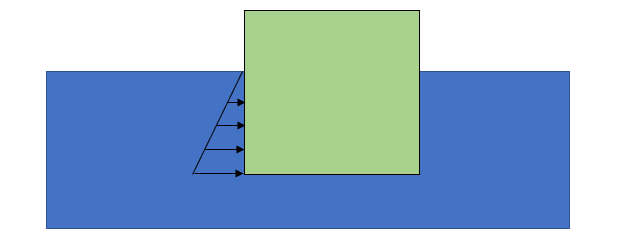
If we imagine a body floating in calm water, the water exerts pressure on it, and the water pressure increases with the body going deeper in water. This pressure is called hydrostatic pressure, and its distribution is something like shown in the figure below:
Besides the hydrostatic pressure, there are hydrodynamic pressure on the vessel. This arises due to the ship reacting to loads from waves, wind and current. These dynamic forces lead to dynamic pressure loads on the vessel. The structural members of the vessel should be able to withstand the total sea pressure loads among other loads. Also, the cyclical nature of wave loads can potentially lead to fatigue damage to the hull in the long run.
Thus, the structural elements of the vessel need to be assessed for these structural and fatigue loads due to the dynamic forces. In this article, we will examine the derivation of dynamic sea loads based on DNV Rules for Classification of Ships, Part 3 Hull, Ch 4 Loads, Section 5.1.
Load Scenarios
Two major types of assessments are covered in DNV Rules – first is the Strength Assessment of the vessel, and the second is Fatigue assessment. For each of them, the design load scenarios are different.
Load Scenarios of Strength Assessment
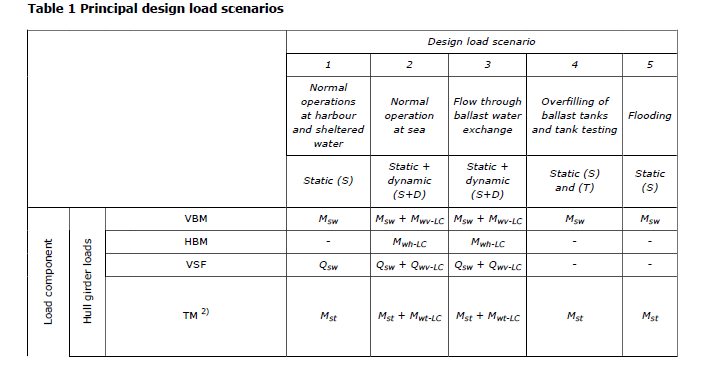
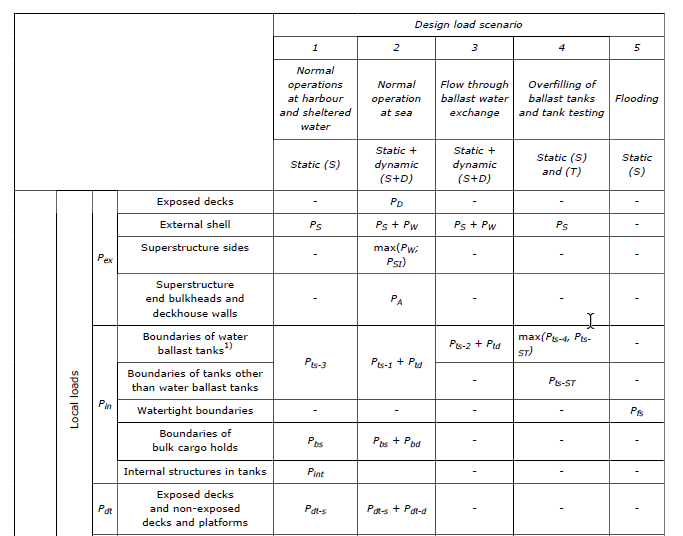
During its lifetime, the vessel may experience different kinds of load scenarios. It experiences different loads when it is in a harbor or at a sheltered location than when it is out in the open sea. Similarly, circumstances like ballast water exchange or tank testing/overfilling of tanks impose different kinds of loads on the tanks. DNV Rules capture these design load scenarios by laying out what kind of loads are applicable to each of these scenarios. Again, two types of loads are listed:
- Hull Girder Loads – Shear, Bending and Torsion
- Local loads – end bulkheads, side shells, internal tank structure, etc.
A snapshot of the DNV load scenarios for the Strength assessment is shown below:
Load Scenarios for Fatigue
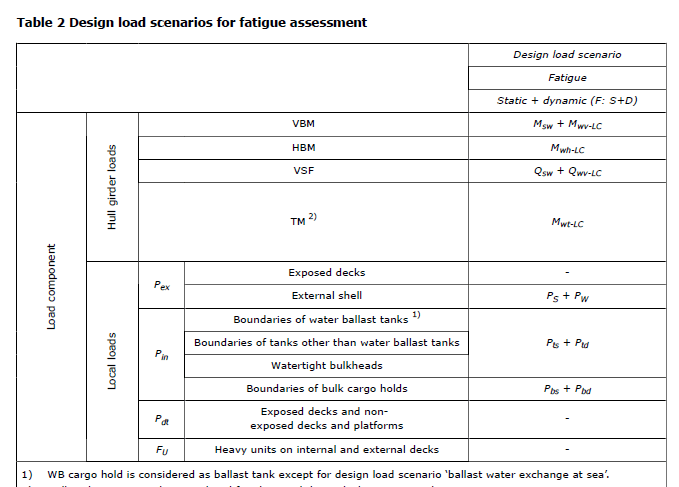
Fatigue takes into account, similarly, both static and dynamic loads. Loads are divided into Hull Girder Loads and Local Loads, and static and dynamic loads are added to get the final load for the load case as applicable. The below snapshot shows the load scenarios for fatigue:
Dynamic Load Cases
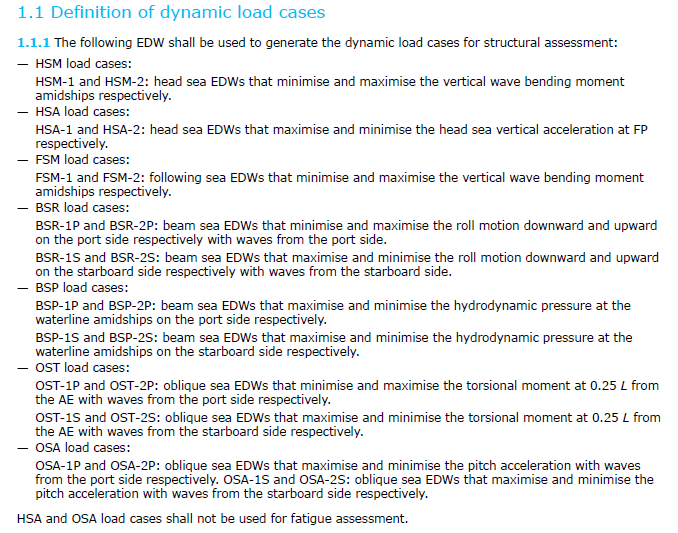
Dynamic load cases are used for determining the dynamic loads required by dynamic load scenarios described in the previous section. These load cases are used for the following:
- Structural assessments:
- Strength assessments of plating, stiffeners, and primary supporting members
- Hull girder strength assessment
- FE assessments for structural members
- Fatigue assessments:
- for structural details covered by simplified stress analysis
- for structural details covered by FE stress analysis
Equivalent Design Wave (EDW)
The sea is comprised of a spectrum of waves. The analysis using full-blown spectra is complicated and time-consuming. The equivalent design wave concept replaces the spectra by a single wave of such height/wavelength which will lead to the same long-term results. EDWs are used to generate dynamic load cases for structural and fatigue assessments. DNV provides the details of the EDWs needed as per the table below:
The methodology
DNV Rules define the empirical formula for calculating the total pressure at any point of the vessel for either only static load scenario or static + dynamic load scenario. The total pressure is defined as a sum of hydrostatic pressure PS and wave pressure PW. Hydrostatic pressure can be simply calculated as ρg*(vertical distance of the point, z, from the waterline, TLC). However dynamic pressure is calculated differently for each dynamic load case as discussed earlier. Several coefficients are included in the calculations to capture effects like non-linearity, wavelength, amplitude, phase, girth distribution, etc. Similar approaches are used both for strength assessment and fatigue assessment.
The scenario-based calculations provided by these rules present a consistent way of calculating loads on a vessel that cover the appropriate mode of operation of the vessel. The dynamic load cases are based on an Equivalent Design Wave (EDW) concept that defines the loads equivalent for a long-term response. Thus, the rule-based calculations increase the durability of the hull structure, reduce the risks of major structural failure and ensure the safety of life, environment, and property.
References
- https://www.researchgate.net/publication/267606741_Comparison_of_Different_Equivalent_Design_Waves_With_Spectral_Analysis#:~:text=In%20a%20broad%20sense%2C%20an,generally%20the%20spectral%20extreme%20response).&text=Those%20waves%20include%20more%20physics,Factor%20above%201%20for%20instance).
- https://www.tandfonline.com/doi/abs/10.1080/17445302.2015.1045268
- DNV Rules for Classification of Ships, Part 3 Hull, Ch 4 Loads
Disclaimer: This post is not meant to be authoritative writing on the topic presented. thenavalarch bears no responsibility for the accuracy of this article, or for any incidents/losses arising due to the use of the information in this article in any operation. It is recommended to seek professional advice before executing any activity which draws on information mentioned in this post. All the figures, drawings, and pictures are property of thenavalarch except where indicated, and may not be copied or distributed without permission.
Powering the maritime industry with Hydrogen – Part 2
Powering the shipping industry with hydrogen - Part 2: Hydrogen propulsion on a ship - opportunities and challenges Introduction In the Part 1 of this article, we explored the basic properties of Hydrogen as a fuel, and also the opportunities and challenges...
A simplified method of performing fatigue analysis of offshore structures
A simplified method of performing fatigue analysis of offshore structures Introduction An offshore structure is subject to environmental loads of waves, wind and current. By their nature, the resulting wave loads on the structure are cyclical. These cyclical...

Powering the shipping industry with hydrogen: opportunities and challenges (Part 1)
Part 1: About Hydrogen – Basics, Opportunities, and Challenges Of late, hydrogen has been generating quite a buzz in the energy sector with its possibility as a clean source of energy. The shipping sector is not untouched, and this article explores the possibilities...
The importance of analysis in nearshore pull-in operation in offshore wind farms
Introduction Over the last 10 years, the global wind energy business has increased manifold. In the next 5 years, the rate of installation is expected to accelerate. This is mostly driven by the opening up of Chinese and US markets. A primary chunk of this market is...
Vessel Draft Survey Accuracy
by Chris Zeringue, Owner, MTS Marine Techincal Surveyors The key to accuracy in a Vessel Draft Survey may very well be found in a hole in the ship. I boarded my...
How to use a ship’s hydrostatics to calculate its draft and trim
Introduction A ship’s hydrostatics, or hydrostats, is an oft used term in maritime parlance, and it refers to the characteristics when it is floating. What characteristics are these? How are these determined, and how can we read and understand them? Understanding...
Numerical integration methods for hull volume estimation
Introduction The hull of a ship is a complex 3D geometry, and finding out its simple properties like volume, centroid, etc. is not possible through simple formulae unlike standard shapes like cuboid or a cylinder. How do we find a property, say the volume of a...
Selecting the right Capstan for berthing a vessel
Introduction Capstans are frequently deployed mooring equipment used on all types of vessels. Capstans are berthing/mooring equipment used to multiply the pulling force on mooring ropes. Traditionally, Capstans were operated manually but in modern ships, they are...
How to do rule-based fitting calculations of a keyless propeller
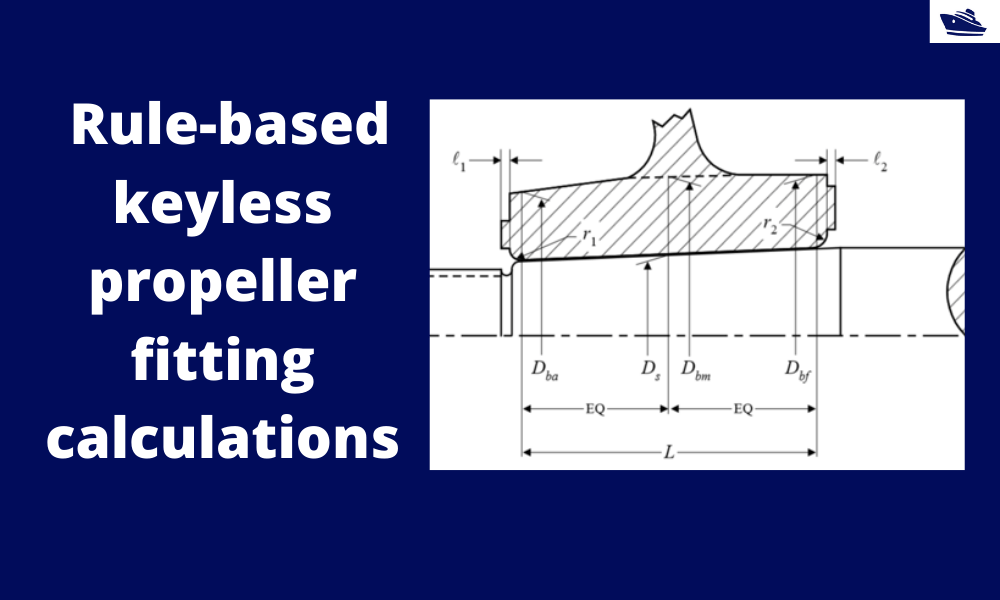
Introduction A keyless propeller, as the name implies, requires no key for fastening the propeller on the cone of the propeller shaft. How is the torque then transferred to the propeller? The torque is transferred by the friction between the propeller and the...
Getting the right thickness of GRP laminate for your boats
Introduction GRP laminates are widely used in the fabrication of high-speed crafts and light crafts/boats globally. GRP stands for Glass Reinforced Plastic. As the name suggests, GRP contains glass fibers embedded into a plastic resin. This gives it higher strength,...
Please check out TheNavalArch’s product for sea pressure loads estimation:

i am interested..
It would be very nice if one could enter the site without all sorts of nonsense. I have been using this site for a very long time but now find it hardly worthwhile. Please explain why you appear top keep changing the method of entry.
Chris R Carrington