
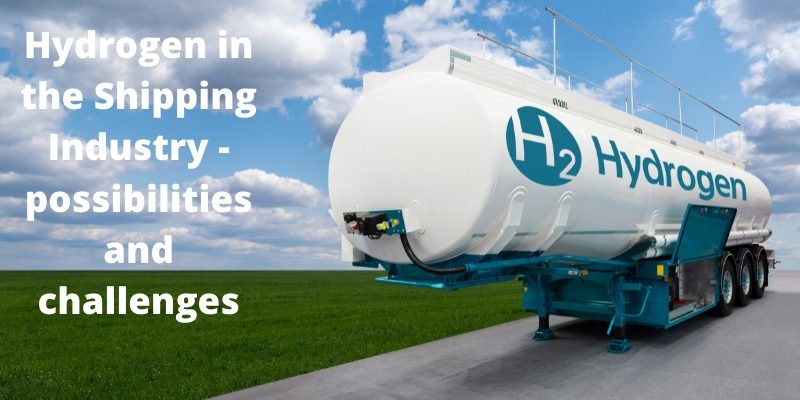
Part 1: About Hydrogen – Basics, Opportunities, and Challenges
Of late, hydrogen has been generating quite a buzz in the energy sector with its possibility as a clean source of energy. The shipping sector is not untouched, and this article explores the possibilities of using hydrogen in various ways to transition the move of the shipping industry to cleaner fuels.
Why Hydrogen?
The shipping industry contributes to 3% of global emissions, and to cut down on these emissions, it is important to switch to cleaner sources of energy. Ships require high power to propel them, and the alternative technologies of wind and solar energy are not sufficient enough to power big cargo ships, as they require high deck space which is simply not available on a ship.
Batteries can be another alternate means of powering. However, with current battery technology, just too many batteries will need to be carried in order for the vessel to go on a long haul. Battery technology can currently be utilized only on small-sized boats and crafts.
With the limitations present with other alternative technologies, can Hydrogen, with its high energy density and zero-emission when burned (it produces water as a by-product) prove to be a viable means to achieve cleaner shipping?
Hydrogen: properties
Let’s first talk about some basic properties of hydrogen.
- It is colorless, odorless, tasteless, and non-poisonous
- It has a high energy content per unit weight (almost three times as much as gasoline). One kg of Hydrogen can produce the same amount of energy as 3.2 kg of gasoline.
- Its energy density per unit volume is about a quarter of gasoline. This necessitates that it be compressed and used as a liquid to make the volume energy density higher.
- It is highly flammable – high safety standards need to be maintained during its storage, transport, and usage.
Green vs Blue Hydrogen
Strictly speaking, Hydrogen can’t be called a fuel as it is not found in its natural state but has to be manufactured. There are two ways of doing it: one by electrolysis of water, and the other by burning fossil fuels through a process called methane reformation. If fossil fuels are burned to produce Hydrogen, it can’t really be called a green fuel – it is just shifting the location of emission. Hydrogen produced this way is called ‘blue hydrogen’. If electrolysis is being used, and the electricity is being produced using renewable sources, then the produced hydrogen is clean and called ‘green hydrogen’.
The current dominant method of commercial production of hydrogen is by burning fossil fuels, and so it can’t really be called a clean fuel. If there’s a commercially viable method for mass production of hydrogen using electrolysis (which is clean), then Hydrogen can become an unparalleled clean fuel.
Advantages
- Abundance – Hydrogen is the most abundant element in nature. The entire world can be powered by hydrogen and we’ll never run out of it.
- Versatility – hydrogen can be used to power vehicles, for energy storage, domestic heating, and industrial use.
- Zero emissions – hydrogen when produced using electrolysis by renewable sources of energy, leads to zero emissions in its complete life cycle.
Challenges
However, does the challenge end once we have a clean method of producing hydrogen? In fact, bigger challenges begin from there:
- Space needed for Storage/Compromising Cargo Space: Hydrogen has a low volume energy density, i.e., for deriving the same amount of energy from hydrogen vs gasoline, a much higher volume of hydrogen is required (4 times more). This can be solved by compressing hydrogen for transport and usage. However, compression requires cryogenic technology as it happens at very low temperatures (-253 degrees C). Even compressed hydrogen takes much more space compared to MDO (Marine Diesel Oil) for the same energy output. Thus, hydrogen may require much more fuel space than conventional fuels: this may cut into the available space for carrying cargo. This will be the biggest challenge for designers and naval architects working on hydrogen-powered vessels.
- Transportation – for the same reason as above, hydrogen’s transportation will require more space. It can be transported via pipelines, or in trucks/containers in a liquid form.
- Flammable: considering it is highly flammable, personnel using and handling it need to be adequately trained in safety issues. Fuel oil tanks filled with hydrogen in a moving vessel are not an idea many are comfortable with.
- Associated Infrastructure: for ships operating worldwide, the infrastructure for fueling, storage and transport of hydrogen needs to be in place for smooth operations
- Regulatory regime: Statutory bodies and Class Societies need to put in place the right set of regulations governing the use of hydrogen in powering ships.
So, while hydrogen looks like a panacea for emissions reduction for the shipping industry, there are still multiple challenges in production, handling, and supply chain that need to be addressed before it can be safely adopted by the industry to usher in the next revolution in shipping. Looking at the level of focus being accorded by governments across the world on hydrogen as a sustainable energy source, it may happen sooner rather than later.
In the next part, we will explore the intricacies in using hydrogen to power ships, look at the different methods to deploy a hydrogen-powered engine, and also look at the regulatory regime.
References
https://www.rechargenews.com/transition/hydrogen-can-power-virtually-all-container-ships-crossing-the-pacific/2-1-767073
https://www.reuters.com/article/shipping-energy-hydrogen-focus-int-idUSKBN27F18U
https://www.bbc.com/future/article/20201127-how-hydrogen-fuel-could-decarbonise-shipping
https://www.popularmechanics.com/science/energy/a926/4199381/#:~:text=Pound%20for%20pound%2C%20hydrogen%20contains,of%20storing%20or%20transporting%20energy.&text=After%20all%2C%20transportation%20represents%20two%2Dthirds%20of%20U.S.%20oil%20consumption.
https://h2tools.org/bestpractices/hydrogen-compared-other-fuels
https://afdc.energy.gov/files/u/publication/fuel_comparison_chart.pdf
https://arena.gov.au/renewable-energy/hydrogen/#:~:text=Hydrogen%20in%20Australia&text=Renewable%20hydrogen%20use%20in%20Australia,be%20sold%20to%20the%20world.
https://www.abc.net.au/news/science/2021-01-23/green-hydrogen-renewable-energy-climate-emissions-explainer/13081872
https://www.nap.edu/read/12032/chapter/9#152
http://www.dalefield.com/slspartners/hydrogen_fm.html
https://www.energy.gov/eere/fuelcells/hydrogen-storage#:~:text=On%20a%20mass%20basis%2C%20hydrogen,44%20MJ%2Fkg%20for%20gasoline.
Disclaimer: This post is not meant to be authoritative writing on the topic presented. thenavalarch bears no responsibility for the accuracy of this article, or for any incidents/losses arising due to the use of the information in this article in any operation. It is recommended to seek professional advice before executing any activity which draws on information mentioned in this post. All the figures, drawings, and pictures are property of thenavalarch except where indicated, and may not be copied or distributed without permission.
Autonomous ships of the future
Automation is in good servant but a bad master!By Dr L R Chari, ex-Executive Director of Shipping Corporation of India (SCI)*This article originally appeared in June 2018 edition of Marine Engineers Review (India), the Journal of Institute of Marine...
The digital transformation of the maritime domain
(This article originally appeared in June 2018 edition of Marine Engineers Review, Vol 12, Issue 7, Journal of The Institute of Marine Engineers (India), and is being reproduced here for readers of TheNavalArch's blog)The maritime domain is gradually...
Selecting the right gear for towing operations – Part 1
Towing operations seem pretty straightforward – we just need to connect the vessel to be towed to the right sized tug and get started! However, a simple exercise of digging deeper will reveal critical items that we need to take care of. If we start thinking about the...
Removing Human Error in Ship Performance Analysis
Introduction Shipping is the most dominant means of transport that facilitate global trade. Over 90% of world trade is done by ships[1]. Fuel onboard ships, commonly referred to as "bunkers", has become the largest cost item of a ship's Operational Expenses (OPEX),...
OCIMF MEG-4 and Mooring Design of your vessels – Part I
Part 1 – Environment and Environmental forcesThe OCIMF (Oil Companies International Marine Forum) has come out with the latest edition of mooring Equipment Guidelines (MEG) – Rev 4. This revision incorporates significant changes and updates over the MEG-3,...

Equipment Numeral Calculation for a Ship – a Guide
Intriguing as it sounds, Equipment Number (or Equipment Numeral) throws a plethora of questions when heard for the first time. Is it something which tells the number of equipment on a ship, or is it a catalog which assigns specific number to the equipment...
CFD in the marine industry: today and tomorrow
In the world of advancing digital technology, it important to identify all the best ways to apply it to the extremely complex task of designing a ship. Riding the wave of the rapid progress of High Performance Computing, Computational Fluid Dynamics (CFD)...
Marine Lifting – Engineering and Planning
Ever since the offshore industry has expanded to deeper waters, one topic of broad and current interest, that has dominated the industry, is the weight of topsides lifted offshore. Installation contractors advertise engineering feats accomplished by...
Transportation Analysis for deck cargo – complete breakdown
Introduction In the simplest terms, Transportation Analysis is the complete design and engineering which goes behind making a transportation operation successful. In this post we'll talk about transportation of project cargo over deck. Such cargo can be equipment,...
Loadout Ramps – design and analysis of the simplest flat plate ramp
Loadouts are a complicated exercise and require intricate engineering calculations to ensure success of the operation. Right from selecting the suitable vessel with adequate ballasting capability, to performing ballasting and stability calculations,...

I have aready registetred!