
,This article first appeared in the Feb 2019 edition of Marine Engineers Review. It is being reproduced with minor edits here for the readers of TheNavalArch’s blog.
Introduction
The world is on facing a grave environmental challenge with an increase in carbon emission and melting polar ice caps, with the average temperature rise predicted to be around 7°C by 2100. As mankind is driving towards the future, more importance is being given to green practices with changing government policies.
The maritime sector has also developed various regulations and conventions to lower the emissions and a new concept of “Zero Emissions”, was derived.
Recent trends in shipping show a huge inclination towards stripping-off emissions to the lowest values possible. We know that the standard fuel cycles are not much efficient even with the various improvisations made over. Fuel cells have proven to be efficient power sources over the last decade with maximum efficiency up to 82% which is almost twice the standard engine cycles. There have been sincere efforts by automobile industries with hybrid vehicles coming into the picture, now it is time for hybrid vessels too.
Vessels can be run using hydrogen power plants with an effective analysis of the total outcomes of using hydrogen as a fuel in terms of profits to the owner and also to the environment. The economic viability of any change is the most important consideration in the industry, inherent with the need for all standards and conventions to be abided by with the least additional equipment onboard.
Hydrogen as a fuel:
Some research shows that the maximum conversion efficiency of fuel cells is limited to the Carnot efficiency. The theoretical efficiency of the fuel cell may exceed that of the Carnot cycle for the same temperature range. The lowest value of maximum efficiency is found to be 79.3, 75.7, 82.1 % of hydrogen-oxygen, hydrogen-air, methane-air fuel cells respectively. By increasing the stoichiometric coefficient of air, the efficiencies of both hydrogen-air and methane-air fuel cells monotonically increase and they approach 100 % limit at a stoichiometric coefficient of 7.2 and 9.8 respectively.
A fuel cell system running on hydrogen can be compact and lightweight and have no major moving parts. Because fuel cells have no moving parts and do not involve combustion in ideal conditions they can achieve 99.999% reliability.
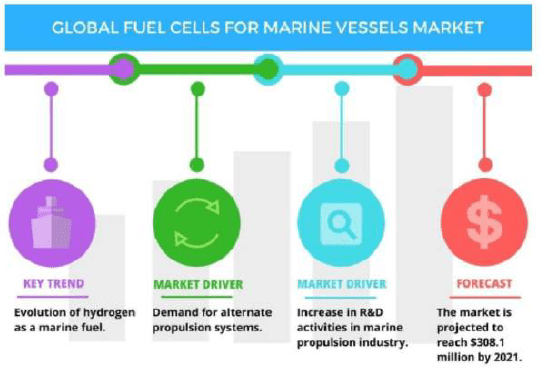
There are many types of fuel cells so the efficiencies vary, but most are between 40-60% energy efficient. However, if the excess vapor produced in the fuel cell is used up the efficiency can rise up to 85%. Significantly more than that of the coal-fired power plants that are only 1/3 times efficient. Assuming production at scale fuel cells can save up to 20 – 40 % on energy costs when used in cogeneration systems. A fuel cell power plant running or hydrogen as a source would produce 1 ounce of pollution (other than CO2) for every 1000kWh of energy. Fuel cells also produce 97% less nitrogen oxide emissions compared to coal-fired power plants. A solitary such program is operating in Stuart Island in Washington state. Solar panels power an electrolyzer, which makes hydrogen. The hydrogen is stored at 500 US gallon (1900L) tanks at 200 PSI and runs a Relion fuel cell to provide full electric backup to the off-grid residence.
Production of hydrogen on a large scale:
There are 6 different methods of production of hydrogen on a large scale.
- Steam Methane reforming (SMR)
- SMR using hydrogen as a fuel in the furnace (SMR+)
- Auto thermal reforming (ATR)
- Partial Oxidation (POX)
- Electrolysis
Requirements for powering ships with hydrogen:
- Electric Propulsion systems.
- Hydrogen storage tanks
- Compatible piping systems for Electric Propulsion System:
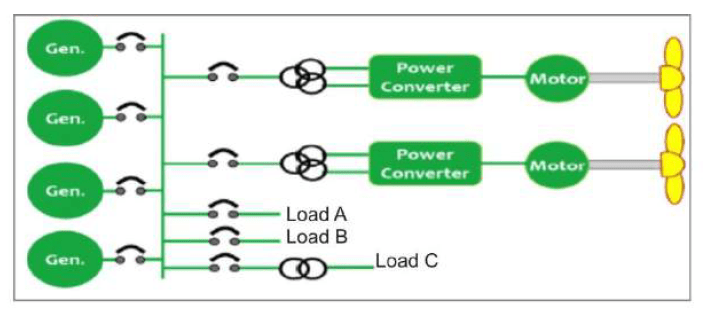
The electric propulsion system would look like below. The electricity produced from the fuel cell generator would be used to drive the propellers. Output equivalent to a 2 stroke diesel engine can be achieved.
Recent Developments & possibilities
In recent conditions, the cost of production. manufacture and dispensing of hydrogen is comparatively much higher when compared to that of fossil fuels. But, what if the hydrogen needed to run the fuel cells is produced onboard itself?
Yes, there is a process to break water into its principal components with the use of sunlight. This photo-electrochemical method is still in the R&D stage. Once we are able to produce hydrogen on a large scale on board there is no need for fueling stations plus in addition, there would be a large cut own in the fuel costs which would benefit the shipowners a lot. All the ship needs are sufficient water onboard & sunlight to run. The vessels in the future will become self-sufficient.
Scottish shipyard Ferguson Marine has successfully led a European consortium —known as HySeas III — in a bid for EU funding to develop the world’s first hydrogen-fuelled commercial ROPAXferry.
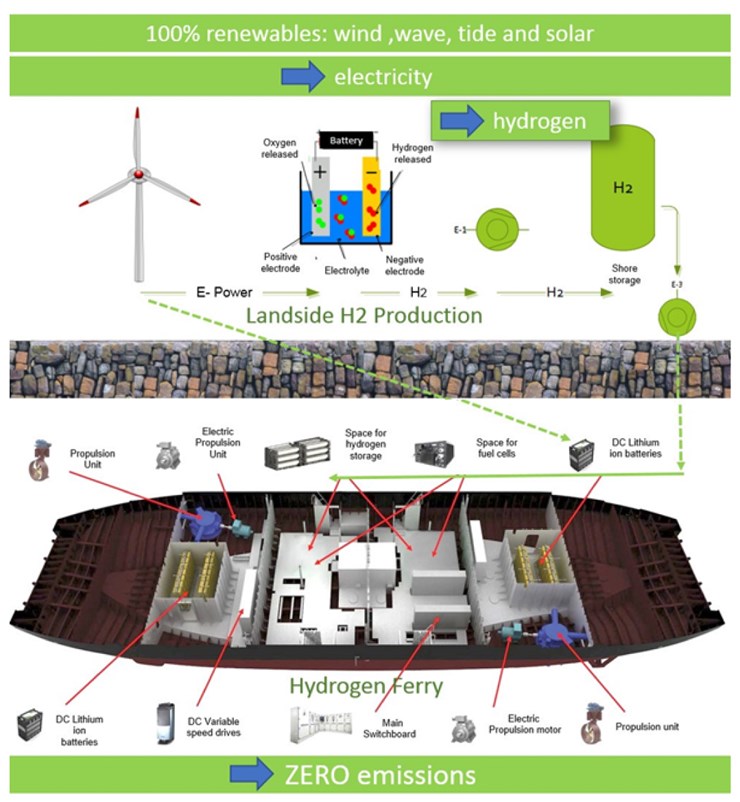
The Hyseas II Project (source: https://www.hyseas3.eu/the-project/)
Hydrogen fuel cells have a long track record of supplying efficient, clean power for a wide range of applications, including forklifts, emergency backup systems. and vehicles. An analysis by Sandia and DOE showed that due to fluctuating toads in maritime auxiliary power applications, a hydrogen fuel cell, which follows the load, is more energy-efficient than a diesel engine. A hydrogen fuel cell only supplies power when it is needed.
Hydrogenics Corp. designed and manufactured a containerized 100-kilowatt hydrogen fuel cell unit. which includes the fuel cell engine, a hydrogen storage system, and power-conversion equipment. Built into a standard shipping container, the unit has an outward appearance and functionality similar to maritime diesel generators that are currently in use.
Viking cruises (Norway) has joined the ranks of companies working to introduce fuel cell technology.
Major commercial ports can produce daily emissions equal to those of half a million cars or more. To combat these environmental impacts, many US ports have begun to adopt green practices. Hydrogen fuel cells have the potential to meet the electrical demands of vessels in ports, as well as supply power for other port uses, such as yard trucks, forklifts, and other material-handling specialty equipment. If implemented, hydrogen fuel cells, which produce zero pollutant emissions and no greenhouse gases at the point of use, can reduce the overall amount of diesel or other maritime fuel used.
Conclusions:
The major concern regarding hydrogen run ships is their economic viability. With the research and developments in the production of hydrogen, the costs can become considerably low in the future. However, there may be a long way till they become equivalent to or cheaper than gasoline or HFO.
Considering the life cycle benefits of the vessels with such systems onboard, the return on investment can be guaranteed, but the shipowner must have the willingness to invest in such a high capital cost project. The storage cost of hydrogen above the ground is also a major challenge to overcome.
In the current conditions, a lot of improvements are needed but soon with such a rate of technological progress. in the upcoming decade, a project with hydrogen as fuel can be suitably viable.
- Hydrogen fueled systems prove far more efficient than the conventional diesel-fueled ones
- Less use of auxiliaries and lesser maintenance required for the systems with very low downtime.
- More cargo accommodation space available since the system has a simplified layout and weighs lighter than a conventional diesel engine
- The water vapor produced as a leftover product can be used for various purposes on board.
Note:
The full version of the paper is available: parties interested can contact the authors
References:
- Master thesis on Concepts of large-scale production of hydrogen by Daniel Jakobson and VegarAtland
- Life cycle cost analysis of Hydrogen versus other electrical technologies for electrical energy storage (D. Stuard, S. Gaur, M. Penev, T. Ramsden)
- Hydrogen Storage Comparison (Susan M. Shoenung – March,19g9)
- Techno-Economic Analysis of Hydrogen Fuel Cell Systems Used as an Electricity Storage Technology in a Wind Farm with Large Amounts of Intermittent Energy (Yash Sanghai -2013)
- Life cycle analysis of Fuel cell technology (S. R. Dhanushkodi, Mahinpey, A. Srinivasan. M. Wilson -March, 20081
- Stationary Fuel cell cost trends (Assessment by NREL. USA)
- A comparison between fuel cells and other alternatives for marine electric power generation (Yousri M. A. Wetaya. M. Morsy El Gohary and Nader R. Ammar – 2011)
- www.nreLgov.in
- wikipedia.com
- www.mproputsion.com
- www.hydrogenics.com
- www.technotogyreview.com
- https://www.hyseas3.eu/the-project/
About the authors:-
- Mr Hare Ram Hare (hareram@imu.ac.in)
F-8893, INE(I), MEO CL-I (Motor), Asst. Prof (Marine Engineering) Marine Engineering & Research Institute (MERI) (Ex-DMET)
Indian Maritime University, Mumbai Port Campus, Sewri, Mumbai-33
- Cadet Sourav Ekbote (bane98uyahoo.co.in)
Marine Engineer, MSC Mediterranean Shipping Co., Marine Engineering & Research Institute(MERI) (Ex-DMET)
Disclaimer: This post is not meant to be authoritative writing on the topic presented. thenavalarch bears no responsibility for the accuracy of this article, or for any incidents/losses arising due to the use of the information in this article in any operation. It is recommended to seek professional advice before executing any activity which draws on information mentioned in this post. All the figures, drawings, and pictures are property of thenavalarch except where indicated, and may not be copied or distributed without permission.
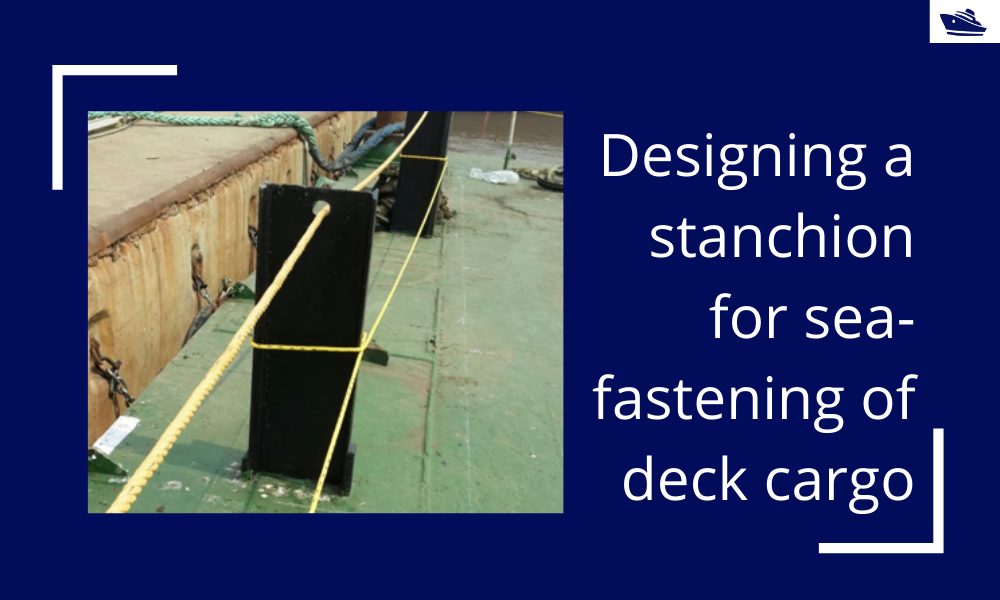
Designing a stanchion/stopper for sea-fastening of deck cargo
Introduction Stanchions – a familiar term for mariners and ship designers. What are Stanchions? A stanchion is generally a vertical pipe or beam which is used to support some structural item or provide support rails on the deck. In ships, the most common type of...
Global wave statistical analysis and its use in deepwater operations
Why do we need wave analysis? For the design of offshore operations such as installation and transport of offshore structures, as well as lifecycle design of floating and fixed structures, knowledge of extreme waves as well as the probability of different sea-states...
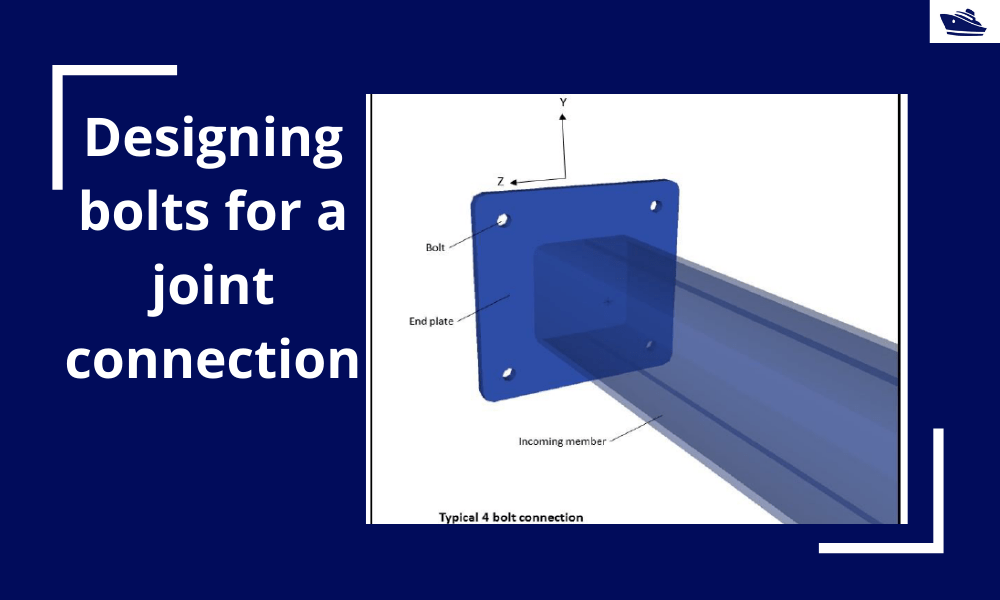
Designing bolts for a joint connection
Introduction Bolts are very commonly used fastening items and used in a variety of configurations. In this article, we will explore in-depth the design of a bolt used in connecting two members at a joint (bolted joint). We'll see what properties of the bolt are...

The why and how of designing a lifting beam
Lifting beams are universally applied gear used widely in various types of lifting operations, onshore and offshore. In this article, we will explore the design of a basic lifting beam and see what design checks are needed to establish the suitability of the beam for...
Draft Surveys: Methodology, Calculations, and common errors
Introduction Marine transport is the backbone of the global trade and reasonably can be considered to be the artery of the global manufacturing supply chain, as more than four fifths of the world merchandise trade by volume is carried by sea. Undoubtfully, the...

Designing a clip/dog plate for seafastening
Introduction In an earlier article, we saw how to design stoppers for seafastening. Stoppers are items that are used to contain the translation movements (longitudinal and transverse directions) of a cargo on the deck/hold of a vessel. That brings us to the question –...

The Bulbous Bow – types, characteristics, and effects
This is Part 2 of the two-part series on Bulbous Bows. For Part 1, click here By Tamal Mukherjee, *This article originally appeared in May 2019 edition of Marine Engineers Review (India), the Journal of Institute of Marine Engineers India. It is being...
Marine Propeller and Shafting Alignment – Part 2
Gap & Sag Alignment Gap and Sag Alignment is carried out to bring the engine to its final position, in case of directly coupled installations, and to bring the gear box to its final position in case of installations with reduction boxes. The figure below indicates...
Marine Propeller Shafting and Shafting Alignment – Part 1
*****This article first appeared in July 2018 edition of Marine Engineers' Review (MER), India. We're reproducing it for the readers of our blog***** Abstract: Since 2013, Shaft Alignment Practice has undergone a change, with developments of Analysis tools. At the...

Using Class Rules to assess the Longitudinal Strength requirement of Barges
Introduction The longitudinal strength of a vessel is integral to its evaluation for a given purpose. To get an introduction to the topic, please refer to our other article https://thenavalarch.com/longitudinal-strength-ships-introduction/ In this article, we’ll see...

Byproduct of hydrogen as a fuel: Steam.
Guess what steam is: greenhouse gas.
Good luck with that.
Just use another dump condenser for the steam being expelled
Thank you for the post. Hydrogen as a fuel will certainly help the industries to maintain the tempo of green environment.
can a electrolizer/fuel cell work on a ship?
Psh! Water vapour just condenses out as precipitation. It doesn’t stick around long enough to affect the climate.
France’s Energy Observer vessel uses an electrolyzer and fuel cell onboard, but production rates are very low. https://www.wgbh.org/news/local/2024-05-17/this-net-zero-boat-could-revolutionize-maritime-travel
Most systems these days use cylinders of compressed hydrogen gas, but Norled built the MF Hydra using liquid hydrogen. https://blog.ballard.com/marine/worlds-first-liquid-powered-hydrogen-ship-mf-hydra-is-powered-by-ballards-fuel-cells