
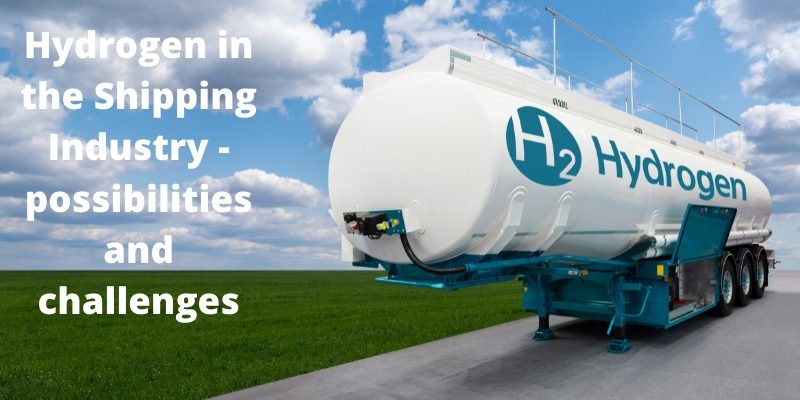
Part 1: About Hydrogen – Basics, Opportunities, and Challenges
Of late, hydrogen has been generating quite a buzz in the energy sector with its possibility as a clean source of energy. The shipping sector is not untouched, and this article explores the possibilities of using hydrogen in various ways to transition the move of the shipping industry to cleaner fuels.
Why Hydrogen?
The shipping industry contributes to 3% of global emissions, and to cut down on these emissions, it is important to switch to cleaner sources of energy. Ships require high power to propel them, and the alternative technologies of wind and solar energy are not sufficient enough to power big cargo ships, as they require high deck space which is simply not available on a ship.
Batteries can be another alternate means of powering. However, with current battery technology, just too many batteries will need to be carried in order for the vessel to go on a long haul. Battery technology can currently be utilized only on small-sized boats and crafts.
With the limitations present with other alternative technologies, can Hydrogen, with its high energy density and zero-emission when burned (it produces water as a by-product) prove to be a viable means to achieve cleaner shipping?
Hydrogen: properties
Let’s first talk about some basic properties of hydrogen.
- It is colorless, odorless, tasteless, and non-poisonous
- It has a high energy content per unit weight (almost three times as much as gasoline). One kg of Hydrogen can produce the same amount of energy as 3.2 kg of gasoline.
- Its energy density per unit volume is about a quarter of gasoline. This necessitates that it be compressed and used as a liquid to make the volume energy density higher.
- It is highly flammable – high safety standards need to be maintained during its storage, transport, and usage.
Green vs Blue Hydrogen
Strictly speaking, Hydrogen can’t be called a fuel as it is not found in its natural state but has to be manufactured. There are two ways of doing it: one by electrolysis of water, and the other by burning fossil fuels through a process called methane reformation. If fossil fuels are burned to produce Hydrogen, it can’t really be called a green fuel – it is just shifting the location of emission. Hydrogen produced this way is called ‘blue hydrogen’. If electrolysis is being used, and the electricity is being produced using renewable sources, then the produced hydrogen is clean and called ‘green hydrogen’.
The current dominant method of commercial production of hydrogen is by burning fossil fuels, and so it can’t really be called a clean fuel. If there’s a commercially viable method for mass production of hydrogen using electrolysis (which is clean), then Hydrogen can become an unparalleled clean fuel.
Advantages
- Abundance – Hydrogen is the most abundant element in nature. The entire world can be powered by hydrogen and we’ll never run out of it.
- Versatility – hydrogen can be used to power vehicles, for energy storage, domestic heating, and industrial use.
- Zero emissions – hydrogen when produced using electrolysis by renewable sources of energy, leads to zero emissions in its complete life cycle.
Challenges
However, does the challenge end once we have a clean method of producing hydrogen? In fact, bigger challenges begin from there:
- Space needed for Storage/Compromising Cargo Space: Hydrogen has a low volume energy density, i.e., for deriving the same amount of energy from hydrogen vs gasoline, a much higher volume of hydrogen is required (4 times more). This can be solved by compressing hydrogen for transport and usage. However, compression requires cryogenic technology as it happens at very low temperatures (-253 degrees C). Even compressed hydrogen takes much more space compared to MDO (Marine Diesel Oil) for the same energy output. Thus, hydrogen may require much more fuel space than conventional fuels: this may cut into the available space for carrying cargo. This will be the biggest challenge for designers and naval architects working on hydrogen-powered vessels.
- Transportation – for the same reason as above, hydrogen’s transportation will require more space. It can be transported via pipelines, or in trucks/containers in a liquid form.
- Flammable: considering it is highly flammable, personnel using and handling it need to be adequately trained in safety issues. Fuel oil tanks filled with hydrogen in a moving vessel are not an idea many are comfortable with.
- Associated Infrastructure: for ships operating worldwide, the infrastructure for fueling, storage and transport of hydrogen needs to be in place for smooth operations
- Regulatory regime: Statutory bodies and Class Societies need to put in place the right set of regulations governing the use of hydrogen in powering ships.
So, while hydrogen looks like a panacea for emissions reduction for the shipping industry, there are still multiple challenges in production, handling, and supply chain that need to be addressed before it can be safely adopted by the industry to usher in the next revolution in shipping. Looking at the level of focus being accorded by governments across the world on hydrogen as a sustainable energy source, it may happen sooner rather than later.
In the next part, we will explore the intricacies in using hydrogen to power ships, look at the different methods to deploy a hydrogen-powered engine, and also look at the regulatory regime.
References
https://www.rechargenews.com/transition/hydrogen-can-power-virtually-all-container-ships-crossing-the-pacific/2-1-767073
https://www.reuters.com/article/shipping-energy-hydrogen-focus-int-idUSKBN27F18U
https://www.bbc.com/future/article/20201127-how-hydrogen-fuel-could-decarbonise-shipping
https://www.popularmechanics.com/science/energy/a926/4199381/#:~:text=Pound%20for%20pound%2C%20hydrogen%20contains,of%20storing%20or%20transporting%20energy.&text=After%20all%2C%20transportation%20represents%20two%2Dthirds%20of%20U.S.%20oil%20consumption.
https://h2tools.org/bestpractices/hydrogen-compared-other-fuels
https://afdc.energy.gov/files/u/publication/fuel_comparison_chart.pdf
https://arena.gov.au/renewable-energy/hydrogen/#:~:text=Hydrogen%20in%20Australia&text=Renewable%20hydrogen%20use%20in%20Australia,be%20sold%20to%20the%20world.
https://www.abc.net.au/news/science/2021-01-23/green-hydrogen-renewable-energy-climate-emissions-explainer/13081872
https://www.nap.edu/read/12032/chapter/9#152
http://www.dalefield.com/slspartners/hydrogen_fm.html
https://www.energy.gov/eere/fuelcells/hydrogen-storage#:~:text=On%20a%20mass%20basis%2C%20hydrogen,44%20MJ%2Fkg%20for%20gasoline.
Disclaimer: This post is not meant to be authoritative writing on the topic presented. thenavalarch bears no responsibility for the accuracy of this article, or for any incidents/losses arising due to the use of the information in this article in any operation. It is recommended to seek professional advice before executing any activity which draws on information mentioned in this post. All the figures, drawings, and pictures are property of thenavalarch except where indicated, and may not be copied or distributed without permission.
A quick empirical method for resistance estimation of planing vessels
Resistance estimation for a vessel is a fundamental exercise in design of the vessel. Resistance is a property that depends on the vessel’s shape and form. A conventional ship-shaped vessel with a bulb will have completely different resistance characteristics compared...
Powering the maritime industry with Hydrogen – Part 2
Powering the shipping industry with hydrogen - Part 2: Hydrogen propulsion on a ship - opportunities and challenges Introduction In the Part 1 of this article, we explored the basic properties of Hydrogen as a fuel, and also the opportunities and challenges...

A simplified method of performing fatigue analysis of offshore structures
A simplified method of performing fatigue analysis of offshore structures Introduction An offshore structure is subject to environmental loads of waves, wind and current. By their nature, the resulting wave loads on the structure are cyclical. These cyclical...
The importance of analysis in nearshore pull-in operation in offshore wind farms
Introduction Over the last 10 years, the global wind energy business has increased manifold. In the next 5 years, the rate of installation is expected to accelerate. This is mostly driven by the opening up of Chinese and US markets. A primary chunk of this market is...

Vessel Draft Survey Accuracy
by Chris Zeringue, Owner, MTS Marine Techincal Surveyors The key to accuracy in a Vessel Draft Survey may very well be found in a hole in the ship. I boarded my...

How to use a ship’s hydrostatics to calculate its draft and trim
Introduction A ship’s hydrostatics, or hydrostats, is an oft used term in maritime parlance, and it refers to the characteristics when it is floating. What characteristics are these? How are these determined, and how can we read and understand them? Understanding...

Numerical integration methods for hull volume estimation
Introduction The hull of a ship is a complex 3D geometry, and finding out its simple properties like volume, centroid, etc. is not possible through simple formulae unlike standard shapes like cuboid or a cylinder. How do we find a property, say the volume of a...
Selecting the right Capstan for berthing a vessel
Introduction Capstans are frequently deployed mooring equipment used on all types of vessels. Capstans are berthing/mooring equipment used to multiply the pulling force on mooring ropes. Traditionally, Capstans were operated manually but in modern ships, they are...
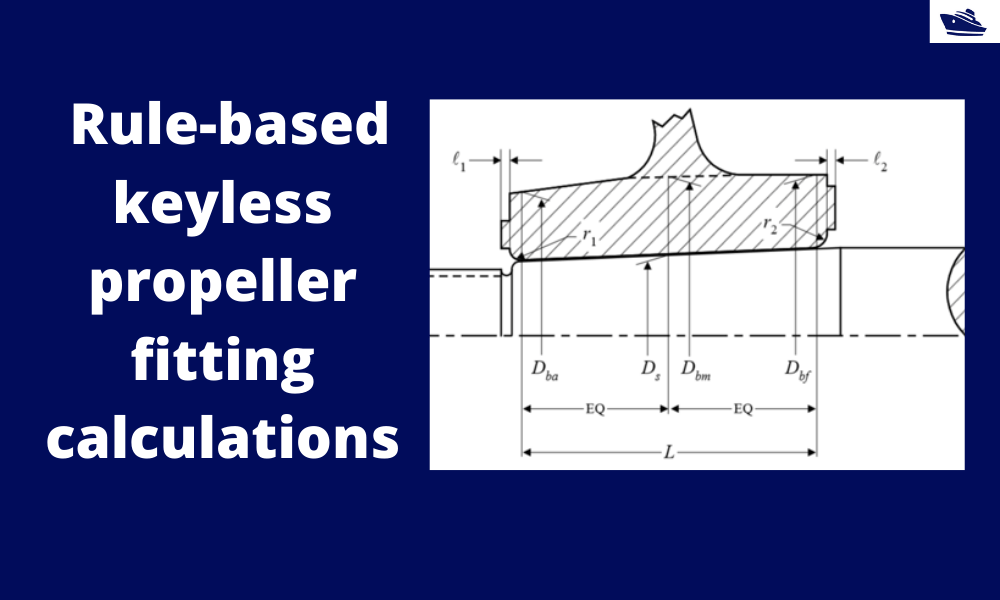
How to do rule-based fitting calculations of a keyless propeller
Introduction A keyless propeller, as the name implies, requires no key for fastening the propeller on the cone of the propeller shaft. How is the torque then transferred to the propeller? The torque is transferred by the friction between the propeller and the...

Getting the right thickness of GRP laminate for your boats
Introduction GRP laminates are widely used in the fabrication of high-speed crafts and light crafts/boats globally. GRP stands for Glass Reinforced Plastic. As the name suggests, GRP contains glass fibers embedded into a plastic resin. This gives it higher strength,...

I have aready registetred!