The Philosophy
Cable hydrodynamic stability is one of the most fundamental design topics which are addressed by cable installation engineers. In its simplest form, a simple force balance approach may be considered to ensure that the cable is not displacing laterally when exposed to the maximum instantaneous hydrodynamic loads associated with extreme met-ocean conditions. If stability can be ensured in a cost-efficient way by applying a minimal amount of concrete weight coating only, this stability method when applied correctly can be regarded as a robust and straightforward approach.
The calculated lateral displacement will typically depend on:
– Cable weight and its hydrodynamic diameter,
– Wave induced water particle velocity
– Water current velocity
– Storm duration and
– Pipe-seabed interaction.
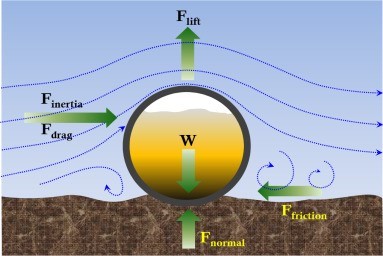
Figure 1: Force diagram of on-bottom stability on pipeline
The DNV Document DNVGL-RP-F109 “On-Bottom Stability of Submarine Pipelines” is currently the industry-accepted guideline to establish the design criteria. Note that although the dimensions applicable for the code suit the pipeline dimensions, the application has been extended to cables and flexibles. Various papers have shown that the application of pipeline guidelines on cable often leads to conservatism.
Limit state
A cable resting on the seabed will be exposed to hydrodynamic loads, both laterally and vertically, from wave – and current induced water particle velocity. If these loads exceed the resistance provided by the pipe seabed interaction, the cable will move.
A cable can be designed to allow for absolutely no lateral displacement and avoiding lift-off by fulfilling the following requirements:
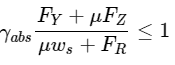
Equation 1: Horizontal stability unity check criteria
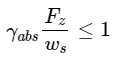
Equation 2: Vertical stability unity check criteria
where the following definitions apply:
FY: Time variable horizontal load acting on the cable under the design wave.
Fz: Time variable vertical load acting on the cable under the design wave.
µ: Coefficient of friction
ws: Cable submerged weight
Fr: Passive soil resistance
γabs: Safety factor for absolute stability
If a cable fulfills this requirement, analyses of the limit states in the following sections are not required. If a certain displacement is allowed, a maximum allowable displacement should be defined by the cable-owner and the design shall be based on dynamic analyses in the time domain during a design storm. The magnitude of the allowable displacement may be governed by e.g. governmental regulations, the width of the surveyed corridor or seabed obstructions. The design criterion can be written on the following general form:
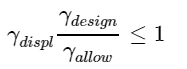
Equation 3: Allowable displacement
Where
γdesign :Estimated lateral displacement during the design storm
γallow :Allowable lateral displacement
γdispl :Safety factor for stability
Safety factors
The safety factor γabs are presented in 3.6.3 in [201] is based on:
- Representative region (North Sea/ Gulf of Mexico or Southern ocean)
- Storm type (Winter storm or cyclonic)
- Soil type (sand/rock / clay)
- Safety factor (Low /mid/ high)
Guidance note:
– For global locations, North sea regulations are recommended.
– Winter storm is normally observed in North Sea
– It is generally conservative to use High safety factor as the factor is suitable for pipelines. Since the burial proportion of the cable is higher, the safety factor is recommended to be low to mid (based on offshore post lay observations.
Design environmental conditions
The as-laid cable is subjected to a design wave generated load. The characteristic load condition shall reflect the most probable extreme response over a specified design time period.
For permanent operational conditions and temporary phases with duration in excess of 12 months, a 100-year return period applies, i.e. the characteristic load condition is the load condition with 10-2 annual exceedance probability. When detailed information about the joint probability of waves and current is not available, this condition may be approximated by the most severe condition among the following two combinations:
1) The 100-year return condition for waves combined with the 10-year return condition for current.
2) The 10-year return condition for waves combined with the 100-year return condition for current.
For a temporary phase with duration less than 12 months but in excess of three days,
a 10-year return period for the actual seasonal environmental condition applies. An approximation to this condition is to use the most severe condition among the following two combinations:
1) The seasonal 10-year return condition for waves combined with the seasonal 1-year return condition for seasonal current.
2) The seasonal 1-year return condition for waves combined with the seasonal 10-year return condition for current.
Make sure that the season covered by the environmental data is sufficient to cover uncertainties in the beginning and end of the temporary condition, e.g. delays.
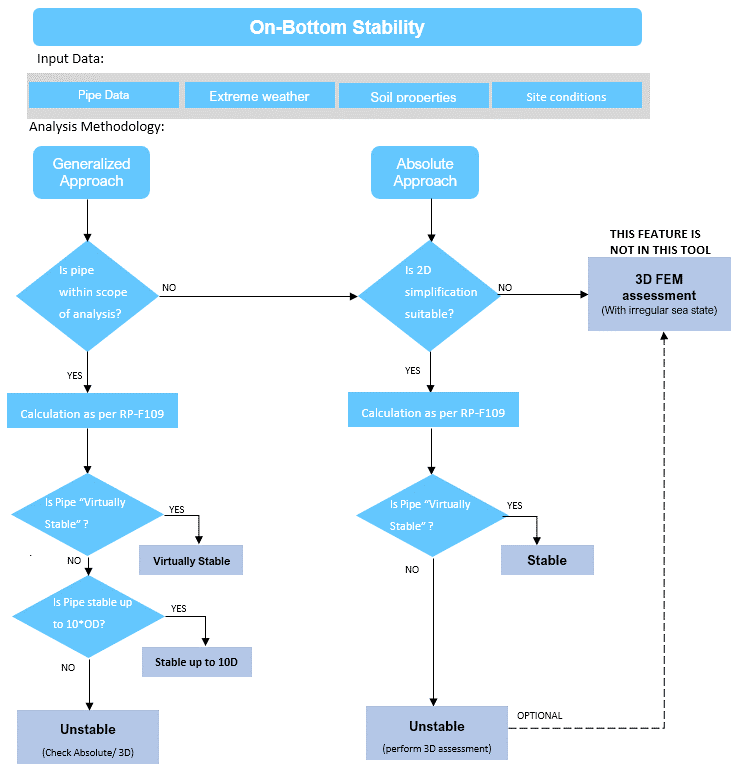
For a temporary phase less than three days, an extreme load condition may be specified based on reliable weather forecasts. The method is summarized in the image below.
Generalized method
Concept
The methodology is based on empirical curves created using various experiments on pipelines. If the cable or pipeline has the specific gravity within limits as prescribed by this method, the cable/pipe is comparable to the tested range. This is a 2D analysis.
The method is based on non-dimensional parameters such as:
K : Keulegan Carpenter Number
L : Weight parameter
M : Steady to oscillatory ratio (Current / Wave)
N : Spectral acceleration factor
Various combinations of K,M,N which account for “Force Contributors”, which are compared against “Resistance Contributing” numbers such as L for two soil types (Sand or clay).
Applicability and limitations
The generalized stability assessment was originally developed for pipelines. The advantage is that it is empirically developed based on actual tests, hence it is quite reliable. Since the influence of bend stiffness and end effects are not considered, the guideline can be applied to cables.
However, the cable must be within following parametric limit.
- Specific weight (sg) is above 1.05
- Environment parameters requiring sg of 3.0 for cable to be stable.
- No penetration is considered
Often the array cables/light pipes do not comply with the stability regime of this method.
Absolute method
Concept
The form of stability is based on force balance between external force and resistance. Due to weight and soil. If the force balance is within the criteria, then the cable is STABLE, else unstable. Both vertical and horizontal stability is assessed.
Formulations are presented in Equation 1 and Equation 2.
The peak horizontal and vertical forces are presented in Equation 6.
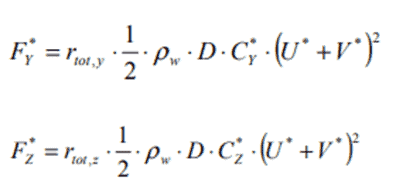
Equation 6: Peak horizontal and vertical excitation load
Where
ρw : Density of water
Cy, Cz : Peak load coefficients (Table 3.9 and Table 3.10 of [201])
rtot : Reduction factor
The force has the form of drag force exerted on the seabed. However, this is not Morison based drag formulation as the coefficients of drag are not applicable to near-seabed conditions. Hence the “coefficients of forces” are evaluated for near-seabed conditions.
Applicability and limitations
The method can be used only if the 2D analysis shows instability. Also, for a highly sloped seabed, where the assumption of a flat seabed is not possible, 3D analysis can be used. It is also possible that the cable after displacement can land into a trench which can lead to stability. These can be observed in the 3D analysis.
However, as mentioned before, the displacement is not based on open water hydrodynamic drag and thus the application of software like OrcaFlex is not suitable. The result is only indicative. Secondly the process of analysis is quite time-consuming.
Also, in the decision-making process, it is recommended to focus on displacement mitigation measures instead of detailed analysis, as the results are not optimistic as per experience.
Usage of the calculation tool
The tool combines both formulations into simple outputs for the initial decision of the pipe layer. Usually the pipe/cable field has multiple kilometers of laid distance. This tool can be used to quickly identify the most critical locations in the field to perform a detailed analysis using 3D approach. The calculation can be done very quickly and the selection of the most critical laid pipe can be done in seconds.
Note that DNV-RP-F109 may not be useful in every soil type and slope, and therefore a detailed analysis is to be done. There are multiple papers presented in international forums where a more site-specific analysis needs to be done, taking into account the bathymetry or soil displacement (like erosion and sedimentation, self-burial, soil liquefaction) These calculations must be done on a very detailed scale using CFD tools. However such exceptional conditions occur on a much smaller scale than majority of cables laid in fields.
Also note that DNV-RP-F109 is a constantly evolving recommended practice that takes note of newer exploration and site experiences from the asset owners. We at TheNavalArch would keep updating the versions keeping an eye on the developments from DNV.
Disclaimer: This post is not meant to be authoritative writing on the topic presented. thenavalarch bears no responsibility for the accuracy of this article, or for any incidents/losses arising due to the use of the information in this article in any operation. It is recommended to seek professional advice before executing any activity which draws on information mentioned in this post. All the figures, drawings, and pictures are property of thenavalarch except where indicated, and may not be copied or distributed without permission.
Designing Fillet Welds for Symmetrical Joint Sections
Introduction Fillet welds are the most commonly used weld types in marine structures. A fillet weld is used when there are two pieces of metal that are joined perpendicular to each other or at an angle. In this article, we will explore how to select the right size...
Designing a stanchion/stopper for sea-fastening of deck cargo
Introduction Stanchions – a familiar term for mariners and ship designers. What are Stanchions? A stanchion is generally a vertical pipe or beam which is used to support some structural item or provide support rails on the deck. In ships, the most common type of...
Hydrogen as an alternative fuel for ships to reduce emissions
,This article first appeared in the Feb 2019 edition of Marine Engineers Review. It is being reproduced with minor edits here for the readers of TheNavalArch's blog. Introduction The world is on facing a grave environmental challenge with an increase in carbon...
Global wave statistical analysis and its use in deepwater operations
Why do we need wave analysis? For the design of offshore operations such as installation and transport of offshore structures, as well as lifecycle design of floating and fixed structures, knowledge of extreme waves as well as the probability of different sea-states...
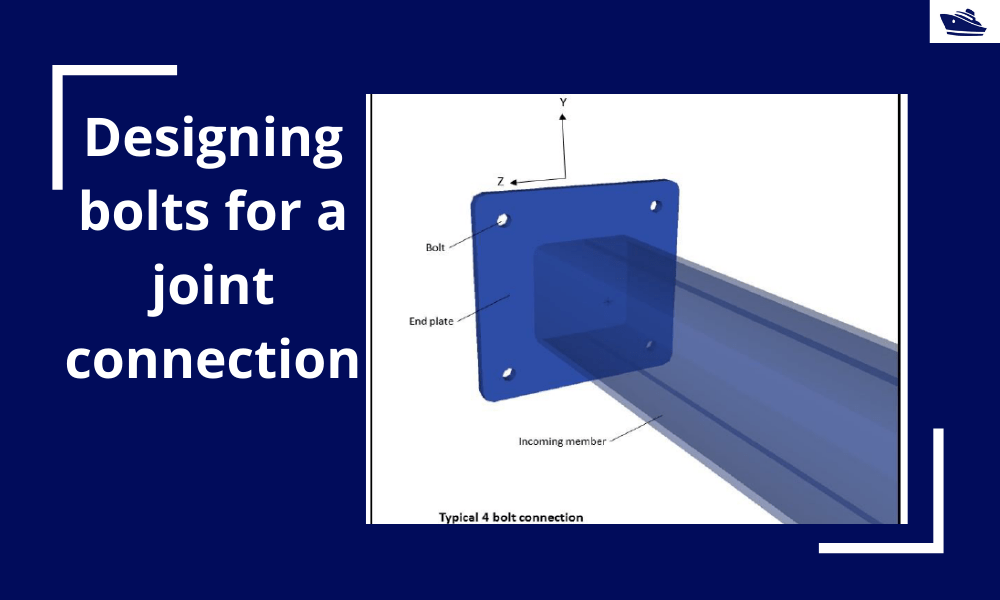
Designing bolts for a joint connection
Introduction Bolts are very commonly used fastening items and used in a variety of configurations. In this article, we will explore in-depth the design of a bolt used in connecting two members at a joint (bolted joint). We'll see what properties of the bolt are...
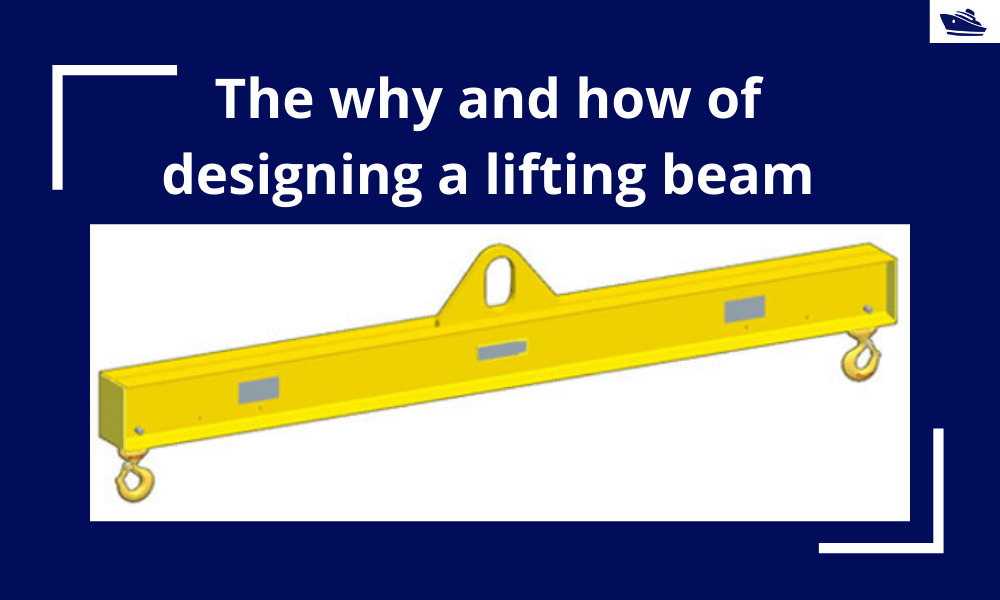
The why and how of designing a lifting beam
Lifting beams are universally applied gear used widely in various types of lifting operations, onshore and offshore. In this article, we will explore the design of a basic lifting beam and see what design checks are needed to establish the suitability of the beam for...
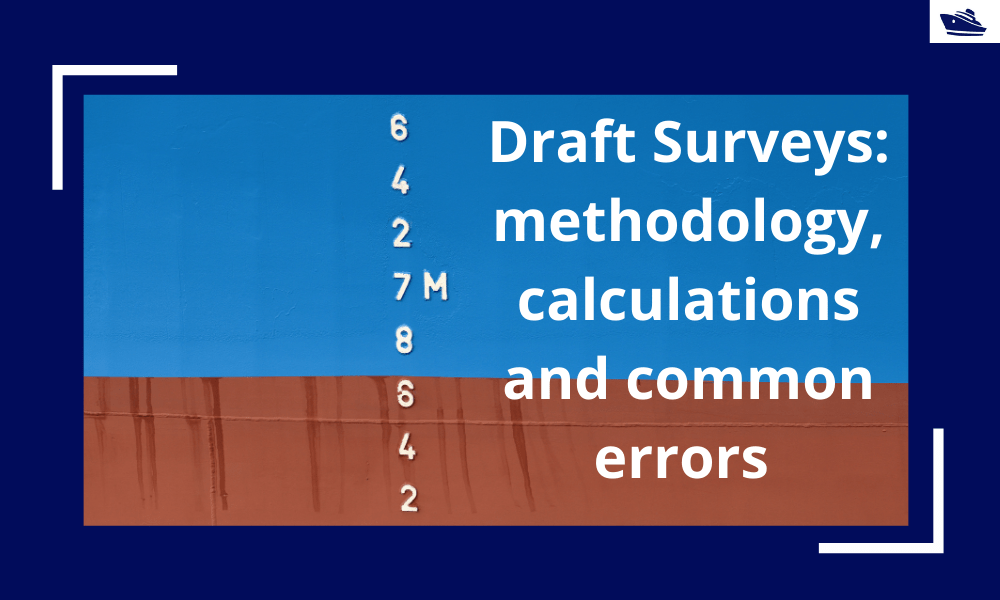
Draft Surveys: Methodology, Calculations, and common errors
Introduction Marine transport is the backbone of the global trade and reasonably can be considered to be the artery of the global manufacturing supply chain, as more than four fifths of the world merchandise trade by volume is carried by sea. Undoubtfully, the...
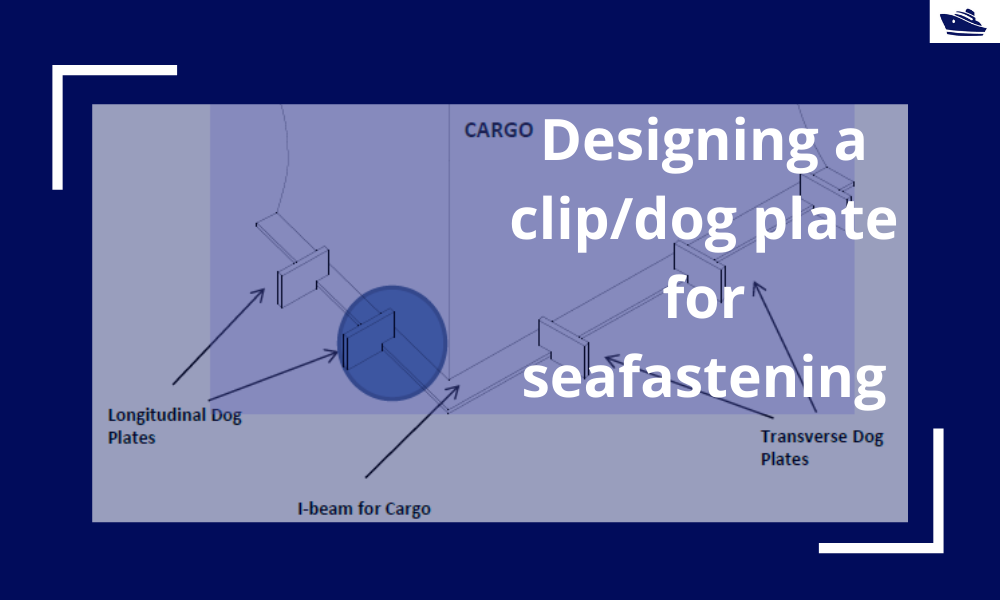
Designing a clip/dog plate for seafastening
Introduction In an earlier article, we saw how to design stoppers for seafastening. Stoppers are items that are used to contain the translation movements (longitudinal and transverse directions) of a cargo on the deck/hold of a vessel. That brings us to the question –...
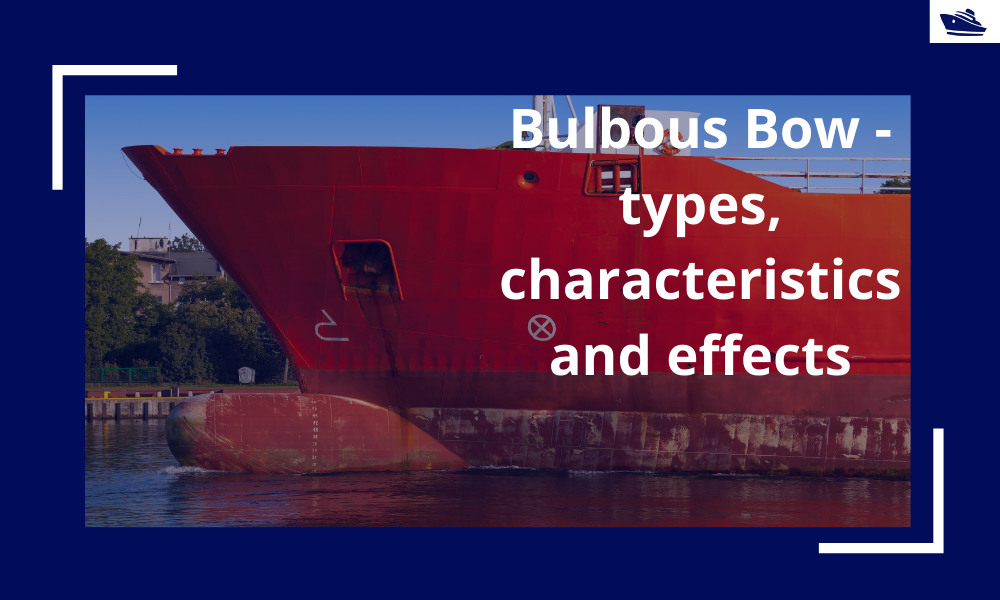
The Bulbous Bow – types, characteristics, and effects
This is Part 2 of the two-part series on Bulbous Bows. For Part 1, click here By Tamal Mukherjee, *This article originally appeared in May 2019 edition of Marine Engineers Review (India), the Journal of Institute of Marine Engineers India. It is being...
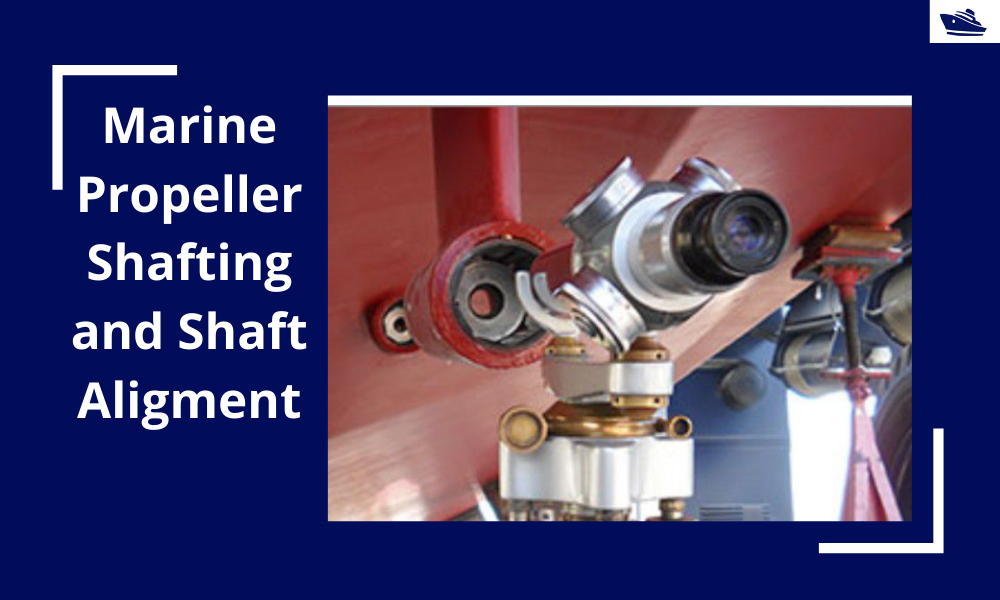
Marine Propeller and Shafting Alignment – Part 2
Gap & Sag Alignment Gap and Sag Alignment is carried out to bring the engine to its final position, in case of directly coupled installations, and to bring the gear box to its final position in case of installations with reduction boxes. The figure below indicates...