
Introduction
The windage area of a vessel or offshore structure is the area that is exposed directly to the wind. As is obvious, this is the area of all items above the waterline. This will include
- Part of the hull/offshore structure above the waterline
- Superstructure/Living Quarters
- Any deck cargo
Calculating the windage area is required when we need to know the wind forces acting on the vessel. The formula for wind force calculation on any structure is:
Wind Force = Pressure x Area exposed to the wind direction
Pressure is given as Pressure = ½ ρV2, where ρ is the density of wind, which is generally taken as 1.23 kg/m3, and V is the wind speed in m/s. The area exposed to the wind direction is also called ‘Windage area’
This article explores the intricacies involved in both the calculation of wind speed and the calculation of the windage area. We take a look at four important factors – Wind Speed & Direction, Height Factor, Shape Factor, and Shielding effects.
Windage Area
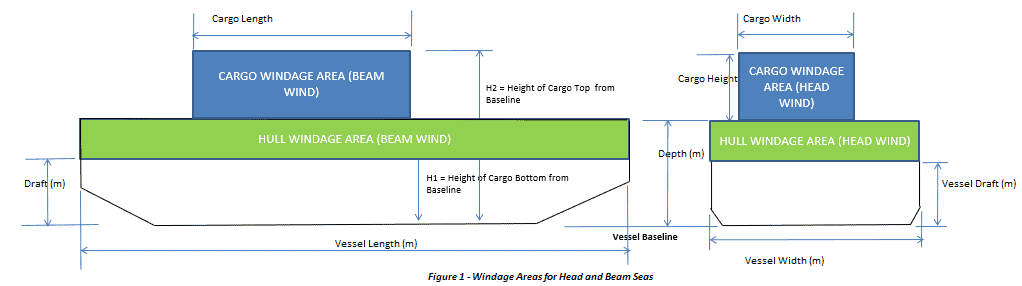
The windage area of a structure is the area exposed to the wind projected at a section that is perpendicular to the wind direction. The windage area from different directions will also be different, depending on the geometry of the structure. This is illustrated in the figure below. We can see that when the wind is from the transverse direction (beam wind), the exposed area of the cargo to the wind is Length x Depth, while for the wind from longitudinal direction (head wind), the exposed area is Breadth x Depth, which is lesser.
What if the wind is not in the transverse or longitudinal direction? What if it is at an angle to the longitudinal axis of the structure? How do we calculate the windage area?
For such cases, there’s a simpler way of estimating the wind force if the transverse and longitudinal windage areas are known. Referring to PNA Vol 2, Sec 5.2, Eq 26 [Ref 2], we can see from the figure below
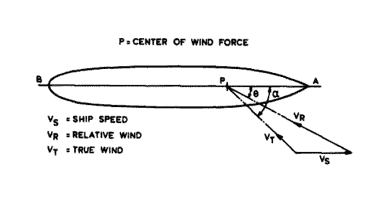
Wind angle calculations (Ref [2])
FW = K * ρair*VR2*(AL sin2θ + AT cos2θ)/cos (α – θ) ………………… (Formula A)
Here the vessel is moving forward with a speed VS, while the true wind is VT at an angle α to the longitudinal axis of the vessel. AL and AT are the projected windage areas for head and beam wind. The value of K varies between 0.5 and 0.65 and is generally taken as 0.6. The above equation can be used even for head and beam wind directions.
Wind Speed and direction
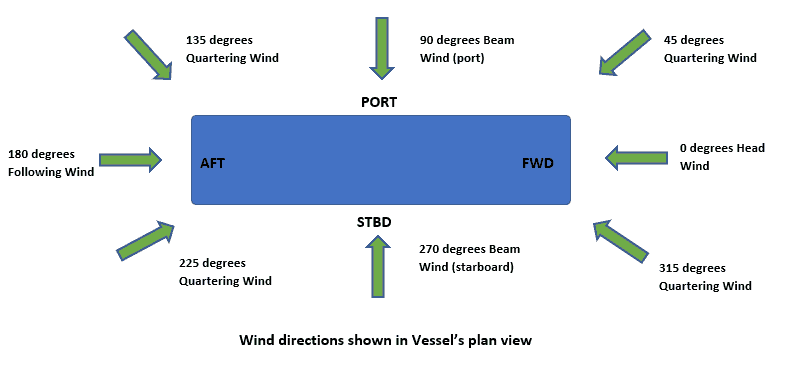
Wind speed is simply the speed at which the wind is blowing. However, it is the direction and height at which the wind is blowing that assume significance when calculating the wind load on a structure. The wind speed can be different in different directions, resulting in varying wind loads. The dominant wind direction and speed have to be taken into consideration for design purposes.
Height Factor
At the same time, the speed of wind also varies with the height of the structure above the water surface. Generally, the wind speed is higher at higher levels of a structure. The effect of height is taken into account by adding a factor called ‘height factor’ in the calculation of the windage area. A structure is divided into different ‘height zones’ depending on its height from the sea level, and different height factors are applied to the windage area of different zones. The height factor can be obtained from standard references like ABS Rules [Ref 1]. These are shown in the figure below:
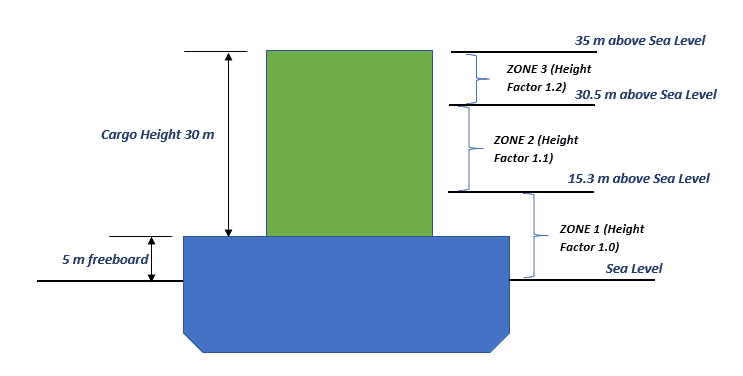
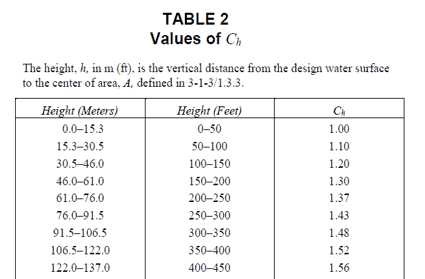
Height factor for different zones (Ref [1])
Shape factor
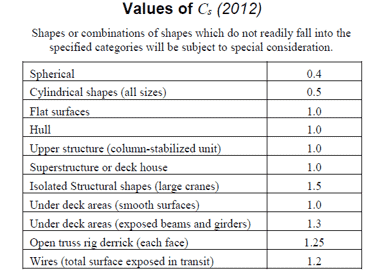
The shape of a structure exposed to wind also influences the wind force that it experiences. For example, a cylinder when exposed to wind will experience lesser force compared to a flat plate of the same projected area exposed to the same wind. The effect of shape on wind force is accounted for by adding a shape factor to the calculation of the windage area. Shape factor can be obtained from standard references like ABS Rules [Ref 1]
Shielding effects

When one structure is blocked by another structure in front of it (the windward frame), then the wind force on the first structure (leeward frame) is expected to be less, and it is called ‘shielded’ by the second structure. This ‘shielding effect’ can be taken into account by factoring the windage area of the shielded structure by a factor called ‘shielding factor’. The shielding factor for a particular structure depends on how solid is the windward frame, and what is the shape of the members comprising the windward frame. DNV-RP-C205 Sec 5.3.3 [Ref 3] provides detailed tables for calculating shielding effects. For a conservative calculation, shielding effects can be ignored.
Calculation
With the understanding of the above factors in wind load calculation, the whole process can be developed into a spreadsheet application that takes as input the details of the vessel, its superstructure and cargo, and calculates the factored windage areas for each of them.
The calculation steps are lined out below:
- Take the vessel’s geometry details from the user. The vessel’s wind area is the part of the vessel above water, i.e., the freeboard of the vessel. The freeboard is divided into different ‘height’ zones depending on how high the freeboard is. From ABS Rules for Building and Classing Mobile Offshore Drilling Units, 2019, C 3-1-2/1.3.2, we can see that the height coefficient is 1.0 for a freeboard of up to 15.3 m. If the vessel’s freeboard is more than 15.3 m (which is generally rare), then the zone of the hull that is at a height more than 15.3 m from the waterline will have to be assigned a height coefficient of 1.1.
- If A1 is the area in Zone 1 (below 15.3 m from waterline), and A2 is the area in Zone 2(more than 15.3 m from the waterline, but less than 30.5 m from waterline), then the total windage area factored for height will be A = 1.0 x A1 + 1.1 x A2. This applies to both longitudinal or transverse areas
- The shape coefficient for the hull is generally taken as 1.0, as the part of the hull above the freeboard is generally flat with near rectangular section.
- Apply a similar method as for the hull to Superstructure and cargo
- For each item, calculate the effective windage area by factoring the different zones with different height coefficients
- Shape coefficients will have to be assigned depending on the shape of the item facing the wind
- The shape coefficient may be different in transverse and longitudinal directions, depending on the shape difference of the cargo in the two directions
- Shielding effects can be applied by following DNV-RP-C205
- If the wind force is required in a direction other than transverse or longitudinal, then use Formula A to get the results
Following the steps above, a fair assessment of the wind forces on a structure can be done.
That brings us to the end of this article. We hope this was useful to you. Please do check TheNavalArch’s own product for windage area calculations that helps you perform this calculation effectively and with a simple user interface.
References
- ABS Rules for Building and Classing Mobile Offshore Drilling Units, 2019, C 3-1-2/1.3.2
- Principles of Naval Architecture, Vol 2, Sec 5.2, Eq 26
- DNV-RP-C205, Sec 5.3.3
Disclaimer: This post is not meant to be authoritative writing on the topic presented. thenavalarch bears no responsibility for the accuracy of this article, or for any incidents/losses arising due to the use of the information in this article in any operation. It is recommended to seek professional advice before executing any activity which draws on information mentioned in this post. All the figures, drawings, and pictures are property of thenavalarch except where indicated, and may not be copied or distributed without permission.
A simplified method of performing fatigue analysis of offshore structures
A simplified method of performing fatigue analysis of offshore structures Introduction An offshore structure is subject to environmental loads of waves, wind and current. By their nature, the resulting wave loads on the structure are cyclical. These cyclical...

Powering the shipping industry with hydrogen: opportunities and challenges (Part 1)
Part 1: About Hydrogen – Basics, Opportunities, and Challenges Of late, hydrogen has been generating quite a buzz in the energy sector with its possibility as a clean source of energy. The shipping sector is not untouched, and this article explores the possibilities...
The importance of analysis in nearshore pull-in operation in offshore wind farms
Introduction Over the last 10 years, the global wind energy business has increased manifold. In the next 5 years, the rate of installation is expected to accelerate. This is mostly driven by the opening up of Chinese and US markets. A primary chunk of this market is...
Vessel Draft Survey Accuracy
by Chris Zeringue, Owner, MTS Marine Techincal Surveyors The key to accuracy in a Vessel Draft Survey may very well be found in a hole in the ship. I boarded my...
How to use a ship’s hydrostatics to calculate its draft and trim
Introduction A ship’s hydrostatics, or hydrostats, is an oft used term in maritime parlance, and it refers to the characteristics when it is floating. What characteristics are these? How are these determined, and how can we read and understand them? Understanding...
Numerical integration methods for hull volume estimation
Introduction The hull of a ship is a complex 3D geometry, and finding out its simple properties like volume, centroid, etc. is not possible through simple formulae unlike standard shapes like cuboid or a cylinder. How do we find a property, say the volume of a...
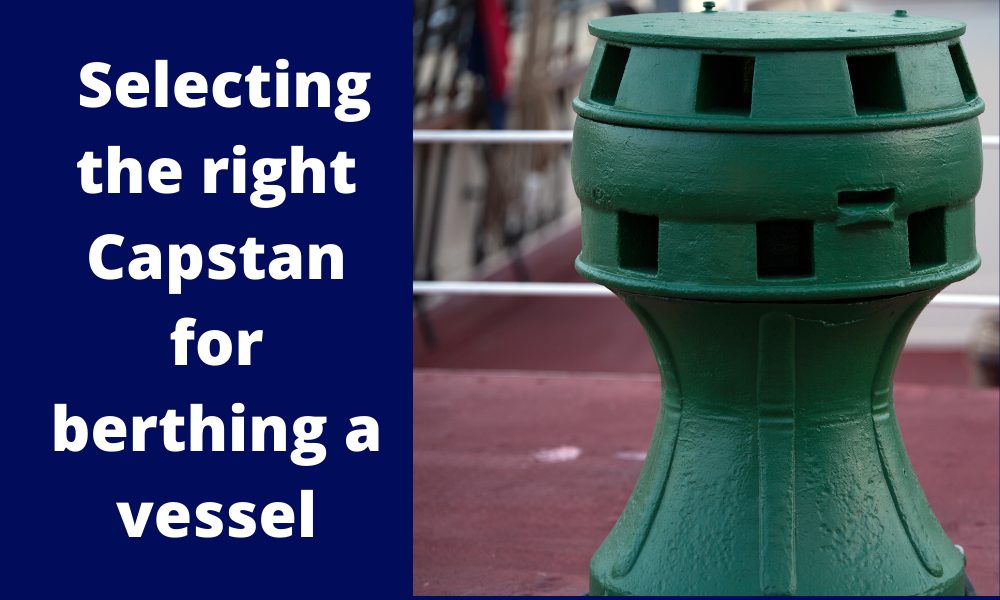
Selecting the right Capstan for berthing a vessel
Introduction Capstans are frequently deployed mooring equipment used on all types of vessels. Capstans are berthing/mooring equipment used to multiply the pulling force on mooring ropes. Traditionally, Capstans were operated manually but in modern ships, they are...
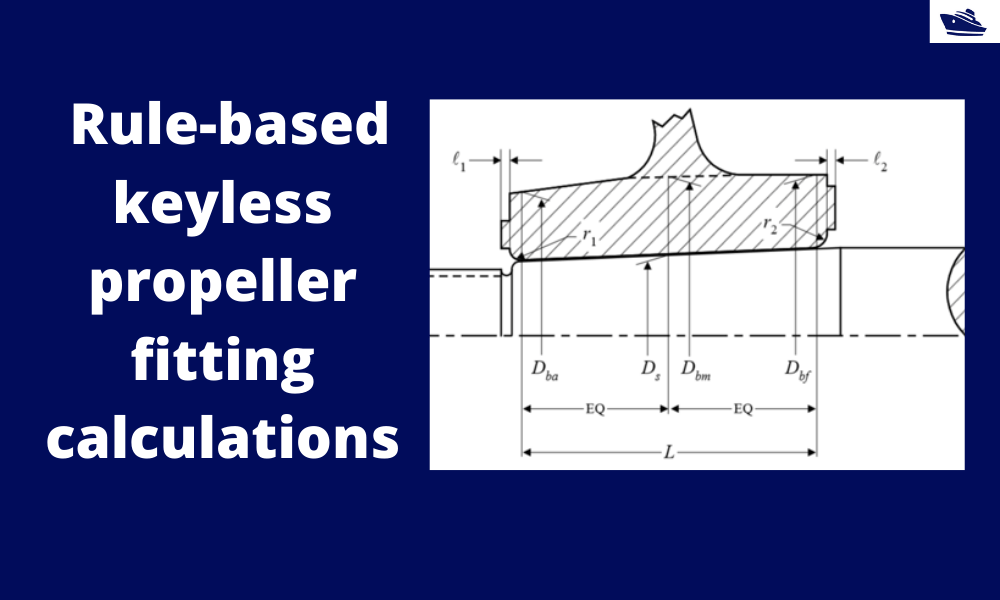
How to do rule-based fitting calculations of a keyless propeller
Introduction A keyless propeller, as the name implies, requires no key for fastening the propeller on the cone of the propeller shaft. How is the torque then transferred to the propeller? The torque is transferred by the friction between the propeller and the...
Getting the right thickness of GRP laminate for your boats
Introduction GRP laminates are widely used in the fabrication of high-speed crafts and light crafts/boats globally. GRP stands for Glass Reinforced Plastic. As the name suggests, GRP contains glass fibers embedded into a plastic resin. This gives it higher strength,...
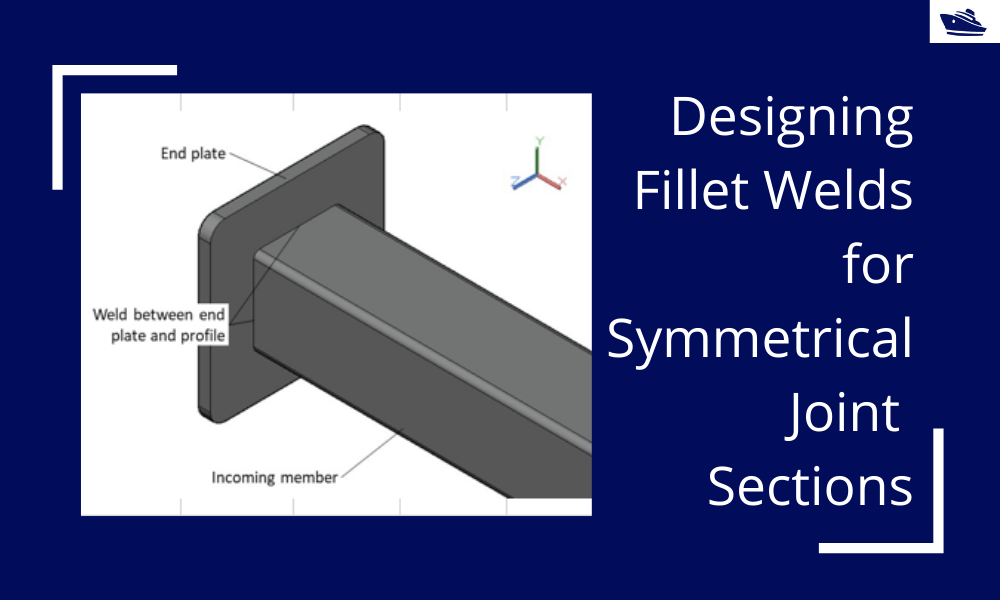
Designing Fillet Welds for Symmetrical Joint Sections
Introduction Fillet welds are the most commonly used weld types in marine structures. A fillet weld is used when there are two pieces of metal that are joined perpendicular to each other or at an angle. In this article, we will explore how to select the right size...

how can calculate the windage area for a Tangeri with 14,7 mtrs of max draft ,lenght 240 mtrs large 42 mtrs
Hi Pietro, can you send us the GA of the vessel to info@thenavalarch.com? Thanks
Very well presented