
Introduction
Bolts are very commonly used fastening items and used in a variety of configurations. In this article, we will explore in-depth the design of a bolt used in connecting two members at a joint (bolted joint). We’ll see what properties of the bolt are important for its sizing, look into the forces the bolt will experience, and also evaluate the stresses which it will experience.
The guidelines/regulations followed for this article are based on Eurocode3.
Bolted Joint
A bolted joint comprises an incoming member welded to an endplate. The endplate has got bolt holes for connection to another member. We can see this in Figure 1 below.
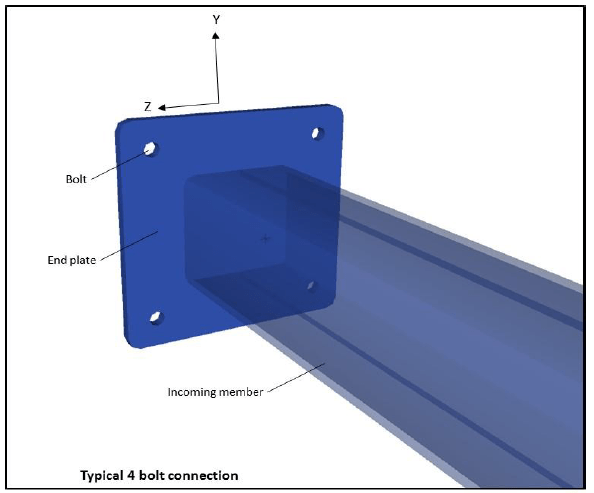
Figure 1 – Typical joint connection
Forces on the bolted joint
Any joint will experience the six degrees of freedom – three translations and three rotations. The three translatory movements will result in forces, while the three rotatory movements will result in moments.
Looking at the figure above, we can see that the forces and moments are as below:
- Axial Force in X-direction
- Shear Force in Y-direction
- Sheer Force in Z-direction
- Moment about X-axis
- Moment about Y-axis
- Moment about Z-axis
The above six forces/moments should be known to the user before commencing the bolt’s design.
Material Properties of endplate and bolts
The material properties of the endplate and the bolts are the starting inputs for the calculations. For the plate, the yield strength, tensile strength, and material factors are needed.
For the bolts, the bolt grade needs to be selected first. The bolt grades specified in Eurocode 3 are A1, A2, A4, 4.6, 4.8, 5.6, 5.8, 6.8, 8.8, and 10.9. The material properties (yield and tensile strength) will depend on the bolt grade. The material factor for the bolts is user input.
Bolt Geometry
The geometry of bolts depends on the class of bolt selected. Different classes of the bolt as per the Eurocode 3 are: M10, M12, M16, M20, M24, M27, M30, and M36. Each of them is characterized by the following properties: bolt diameter, bolt hole diameter, and bolt area.
Plate Geometry
The plate geometry is characterized by the following:
- Endplate thickness tp
- End distances between plate edge and bolt e1 & e2
- Spacings between the bolts in the y and z directions p1 & p2
Figure 2 below illustrated the plate geometry inputs
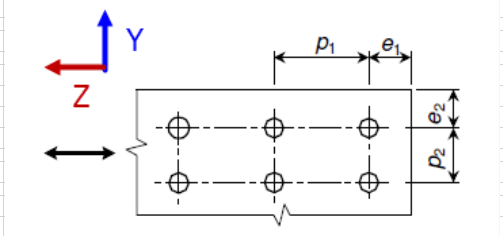
Figure 2 Plate Geometry Inputs
Geometry Checks
The spacing of bolts, the end distances from the plate, etc. are subject to some minimum requirements. These are shown below.
p1,p2,e1,e2 are the distances as shown in figure 2, and d0 is the bolt hole diameter, while tp is the plate thickness
With the inputs and geometry check in place, stress assessments of the bolts is the next step.
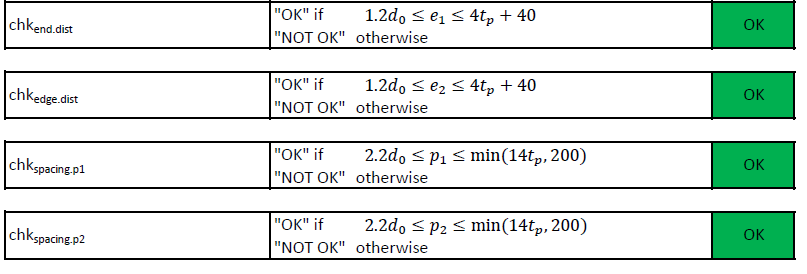
Figure 3 Bolt Geometry Checks
Forces and moments
The total forces and moments on the joint are taken by the total number of bolts. The forces and moments on a bolt can be calculated from the forces and moments on the joints. For example, the tensile force on the bolts can be found by dividing the total axial force by the number of bolts, and adding to it the axial forces arising from the moments in the Y and Z directions (by dividing the moments by the lever arm of the moment). Similarly, the shear force can be found out as the resultant of the joint forces in Y and Z directions and adding to it the shear force arising due to the moment in the axial direction.
Design resistances and capacity checks
The checks for an individual bolt can be performed by calculating the design resistances of a bolt. These include the following and are derived from the material and geometrical properties of the bolt
- Shear resistance
- Tension resistance
- Bearing resistance
- Punching shear resistance
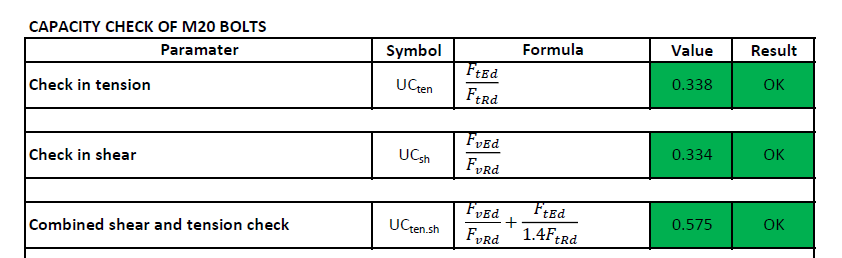
Following the above, the checks for the bolt’s design are performed to calculate the different unity checks as listed below.
- Check in tension
- Check in shear
- Combined shear and tension check
- Bearing Resistance Check
- For end bolts
- For inner bolts
- Punching Shear check
Each of the above checks should result in a UC value of less than 1.0 for the bolt.
That completes this article on designing bolts for joint connections. Please do check out TheNavalArch’s own app on bolt design, and let us know in the comments section if you have any queries.
Disclaimer: This post is not meant to be authoritative writing on the topic presented. thenavalarch bears no responsibility for the accuracy of this article, or for any incidents/losses arising due to the use of the information in this article in any operation. It is recommended to seek professional advice before executing any activity which draws on information mentioned in this post. All the figures, drawings, and pictures are property of thenavalarch except where indicated, and may not be copied or distributed without permission.

Getting the right thickness of GRP laminate for your boats
Introduction GRP laminates are widely used in the fabrication of high-speed crafts and light crafts/boats globally. GRP stands for Glass Reinforced Plastic. As the name suggests, GRP contains glass fibers embedded into a plastic resin. This gives it higher strength,...
Designing Fillet Welds for Symmetrical Joint Sections
Introduction Fillet welds are the most commonly used weld types in marine structures. A fillet weld is used when there are two pieces of metal that are joined perpendicular to each other or at an angle. In this article, we will explore how to select the right size...
Designing a stanchion/stopper for sea-fastening of deck cargo
Introduction Stanchions – a familiar term for mariners and ship designers. What are Stanchions? A stanchion is generally a vertical pipe or beam which is used to support some structural item or provide support rails on the deck. In ships, the most common type of...

Hydrogen as an alternative fuel for ships to reduce emissions
,This article first appeared in the Feb 2019 edition of Marine Engineers Review. It is being reproduced with minor edits here for the readers of TheNavalArch's blog. Introduction The world is on facing a grave environmental challenge with an increase in carbon...

Global wave statistical analysis and its use in deepwater operations
Why do we need wave analysis? For the design of offshore operations such as installation and transport of offshore structures, as well as lifecycle design of floating and fixed structures, knowledge of extreme waves as well as the probability of different sea-states...
The why and how of designing a lifting beam
Lifting beams are universally applied gear used widely in various types of lifting operations, onshore and offshore. In this article, we will explore the design of a basic lifting beam and see what design checks are needed to establish the suitability of the beam for...
Draft Surveys: Methodology, Calculations, and common errors
Introduction Marine transport is the backbone of the global trade and reasonably can be considered to be the artery of the global manufacturing supply chain, as more than four fifths of the world merchandise trade by volume is carried by sea. Undoubtfully, the...
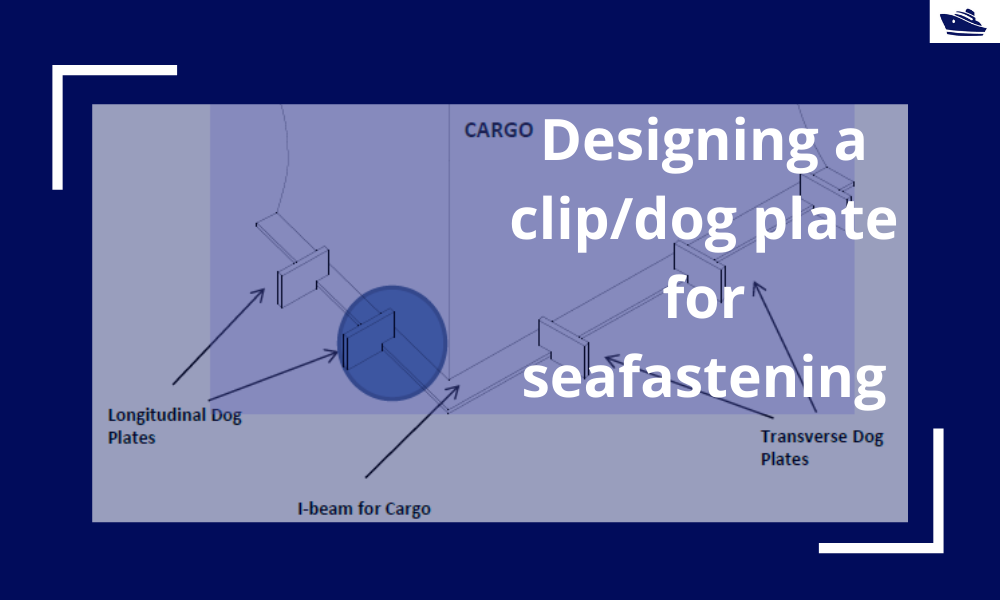
Designing a clip/dog plate for seafastening
Introduction In an earlier article, we saw how to design stoppers for seafastening. Stoppers are items that are used to contain the translation movements (longitudinal and transverse directions) of a cargo on the deck/hold of a vessel. That brings us to the question –...
The Bulbous Bow – types, characteristics, and effects
This is Part 2 of the two-part series on Bulbous Bows. For Part 1, click here By Tamal Mukherjee, *This article originally appeared in May 2019 edition of Marine Engineers Review (India), the Journal of Institute of Marine Engineers India. It is being...
Marine Propeller and Shafting Alignment – Part 2
Gap & Sag Alignment Gap and Sag Alignment is carried out to bring the engine to its final position, in case of directly coupled installations, and to bring the gear box to its final position in case of installations with reduction boxes. The figure below indicates...

N/A